Showing posts with label foundation for pluralism. Show all posts

Saturday, January 14, 2012

Mitt Romney, you can do this, others don’t have the balls.


I was concerned with Romney's statements earlier on that bordered on bigotry, but he has done very well with his response to a question by a woman, "Do you believe in the divine saving grace of Jesus Christ?"

"I would hope that there are people in our nation that have different beliefs. There are people of the Jewish faith and the Islamic faith and other faiths who believe other things, and our president will be president of the people of all faiths," he said.

"We welcome people of other faiths. I happen to believe that Jesus Christ is the Son of God and my savior, but I know other people have differing views and I respect those views, and I don't believe those qualify or disqualify people for leadership in our nation," he said.


Indeed I am working on developing leadership programs to train our future leaders to be free from bigotry at America Together Foundation.


Here is an item I wrote way back and you ~nearly pass my test of Pluralism.

We are one nation under God, indivisible with liberty and justice for all. We are represented by every race, nationality, ethnicity, language, culture and religion. We see God as one, none and many and in every form; male, female, genderless and non-existent, being and non-being, nameless and with innumerable names. Americans together are committed to preserve this pluralistic heritage of America.


You may really like this Pluralism Prayer, if you can subscribe to this, you have won me as an individual and I will do these prayers for you in one of your debates or fund raising.


Actual Prayer in Carrollton City Hall – Congressman Kenny Marchant has listened to this; http://www.youtube.com/watch?v=8mc9D9guPMY&feature=youtu.be

Americans Together building Cohesive societies

OUR MISSION

Our Mission is to build a cohesive America, where no American has to live in anxieties, discomfort or fear of the other.

OUR VISION

It is our individual and collective responsibility to keep law and order and faithfully guard the safety of every citizen. Hate, prejudice and stereotyping are some of the many root causes of disrupting the peace in a society and it is our duty to track down the source of such ill-will and work on mitigating it.
We believe humans are open to choices and will make best choices if the path is paved for them. It has been our experience through our annual events like Unity Day, Reflections on Holocaust and Genocides, Thanksgiving, Conferences, that our participants have walked out with a commitment to be less biased, less prejudiced and willing to stand up for the others for the sake of general good of mankind.

We are committed to enhance the efforts nationally, one brick at time in building a cohesive America, where each one of the 312 Million Americans feel safe in their homes, at their jobs, places of worship and in the public places.

Mike Ghouse is committed to building a cohesive America where no American has to live in apprehension, discomfort or fear of the other – www.MikeGhouse.net

ROMNEY, YOU CAN DO THIS, OTHER BIGOTS DON'T HAVE THE BALLS
http://theghousediary.blogspot.com/2012/01/mitt-romney-you-can-do-this-others-dont.html


OTHER ROMNEY LINKS :: I WROTE 11 ITEMS ON ROMNEY?
Mitt Romney, you can do this, others don’t have the balls.
http://theghousediary.blogspot.com/2012/01/mitt-romney-you-can-do-this-others-dont.html
- - - - -
Evangelicals are ganging up on Romney
http://theghousediary.blogspot.com/2012/01/texas-faith-evangelical-leaders-finding.html
- - - - -
- - - - -
- - - - -
The Ghouse Diary: IOWA REPUBLICAN CAUCUS NOTES
http://theghousediary.blogspot.com/2012/01/iowa-republican-caucus-notes.html
- - - - -
Texas Faith: How should Huntsman and Romney handle their Mormonism?
http://theghousediary.blogspot.com/2011/06/texas-faith-how-should-huntsman-and.html
- - - - -
Perry will be the nominee if he keeps up

Monday, December 19, 2011

Bigotry against Hinduism in Russia

Incredible attack on the Holy Bhagvad Gita
http://theghousediary.blogspot.com/2011/12/bigotry-against-hinduism-in-russia.html


You and I have allowed blatant bigotry to be preached on our land unquestioned and unchecked. The damned thing is contagious and spreading to Russia and other nations. Bigotry exists not because of bigots, but because we have not spoken out against it.

Six years ago in December of 2006, the Archbishop of Russia called Krishna a Satan, and five years ago, the city of Moscow made serious attempts to usurp the land belonging to Krishna Temple. Of course, a few of us wrote about it and now per the news reports, the "Bhagvad Gita, one of the holiest Hindu scriptures, is facing a legal ban and the prospect of being branded as "an extremist" literature across Russia. A court in Siberia's Tomsk city is set to deliver its final verdict Monday in a case filed by state prosecutors." I would have never thought this day would come, when Bhagvad Gita would be attacked, the sacred text of Hinduism, it is rather a dialogue on reflections of one's conscience. It is one of the best self help books to find answers to the eternal questions about righteousness and one's duty to the self and the world. Hinduism is not a proselyting religion and Bhagvad Gita should not threaten any one of those weak men of religion.

The Holy Qur'aan has been deliberately mistranslated by medieval European Kings to paint Islam in bad light so they can frighten their subjects and buy their loyalty, and of course a Muslim Hilali Khan matched those kings and injected words into the translations that were not in Quraan, he wanted to build up ill-will against Jews and Christians for his presumed gain to restore the Caliphate. He has mistranslated nearly 60 Verses of Quraan. Fortunately there are still 20+ translations that are good, and thank God for that, the Arabic text has remained intact, although a group of proselytizing Christians have made attempts to mis-write Arabic version of Quraan in late eighties and distribute it in Kuwait. The best available translation is by Muhammad Asad, even this needs updating, but a good guide.

The attacks on Quraan and Bhagvad Gita are not based on knowledge but based on selling hate and collecting cash from the gullible congregants who trust the fox that guards the hen, all in the name of the man who taught to tell the truth and love thy enemy.

The good news is this bigotry is controllable, it has afflicted less than a percent of the population, and all of us together have to work on keeping those cancer cells from multiplying and harming our civilization and our civility.

I urge Non-Hindus to pick up the phone and call the Russian Embassy, if you cannot stand up for others, why should anyone stand up for you? The least you can do is fax a few words to their embassy "This is not a good thing" or write your comments at www.facebook.com/speakermikeghouse or in the comment section of www.Theghousediary.com

Russian Embassy
2650 Wisconsin Ave, NW
Washington, CD 2007
Tel: 202-298-5700
Fax: 202-298-5735

Please remain polite and ask their government to take responsible action and not let a few among them dictate a national policy. We are a small world, interdependent, interconnected and one fragile unit. Let's preserve it.

When Robert Jeffress, Pat Robertson, Jerry Falwell, John Hagee, Herman Cain, Tom Tancredo, Rick Santorum, Newt Gingrich and a bunch of talk show hosts spewed hate against fellow Americans, very few of us have spoken out against them in public medium, and they take that as an encouragement and spill out more. You and I are further responsible for remaining silent, when they make shameless comments against Jews, Muslims, Mormons, Wicca, GLBT, Hindus and other. This is not the America we want, nor is this world we like to see. We have to enter into a positive dialogue with a singular goal of building cohesive societies where none of us have to live in apprehension of the other.

We hope to resume the workshops on Religion, every religion to remove the myths about each religion.http://wisdomofreligion.blogspot.com/2007/04/understanding-hinduism-workshops-by.html

Mike Ghouse is committed to do his share of building a cohesive world and offers pluralistic solutions on issues of the day. His work is indexed at www.MikeGhouse.net and his current articles can be found at www.Theghousediary.com

Friday, October 15, 2010

One on One with the Aga Khan

THE AGA KHAN

by Peter Mansbridge

A portrait of Peter Mansbridge of CBC Canada. Photo Credit: Photo by Dustin Rabin.com, Toronto – July 25, 2007. Copyright: Dustin Rabin.
Editor’s Note: The following interview has been excerpted from Peter Mansbridge One on One by Peter Mansbridge. Copyright © 2009 Peter Mansbridge. Interview Material © Canadian Broadcasting Corporation. Reprinted by permission of Random House Canada.

The Story Behind the Interview

There are about eighty thousand Ismaili Canadians in our country, and when I decided to interview their spiritual leader, the Aga Khan, his Canadian representatives told me that every single one of them would be watching. They weren’t kidding. Every time I meet an Ismaili Canadian, whether in Edmonton, Calgary, Toronto, Ottawa or any of the other urban areas they seem to favour, I’m stopped and told how great the interview was. One on One airs at least three times every weekend on the CBC, and one of those airings is in the middle of the night.
The audiences at that time are understandably small – often no more than fifteen thousand. So I had to smile when I saw the overnight ratings the first time the Aga Khan’s interview ran: eighty thousand.
Ismailis are a minority in the Muslim faith; in fact, some Muslims don’t even recognize them as Muslims. Their history is deep, ancient and to a degree bitter. Ismailis broke away from the main Shiite Muslim faith about twelve hundred years ago over who best represented the true Imam, or leader of Islam. I’ve seen some Ismaili friends at work shunned by other Muslims, who refused to accept them as friends and barely acknowledged them
as colleagues.
His Highness Prince Karim Aga Khan is the leader of the world’s Ismaili community, and he has spent many of his fifty years as the Aga Khan trying to counter those differences. He’s become a well-known and well respected international figure and his admirers exist far beyond his faith. He established the Aga Khan Foundation to improve living conditions and opportunities for the poor, whatever their faith, origin or gender. He was a great friend of Pierre Trudeau; his trips to this country during the Trudeau years were frequent and they continue that way now.
While the Trudeau relationship became broader in scope, it was based on the former prime minister’s decision in the early seventies to admit to Canada thousands of Asians who had been expelled from Uganda by the brutal dictator Idi Amin. Many of the new arrivals were Ismaili, and they, and the Aga Khan, have never forgotten Canada’s open doors in their time of need.
All of those points had made me determined to invite the Aga Khan onto One on One during one of his frequent Canadian visits. The opportunity came in early 2007.
When I flew to Ottawa for the interview, I took with me a good friend and colleague. Sherali Najak is the executive producer of Hockey Night in Canada, and years ago he worked with us on The National. He’d begged me and my regular director, Fred Parker, to let him direct the Aga Khan shoot. Freddie, normally very protective of his turf, said, “Absolutely,” and so did I. Sherali, you see, is Ismaili. His family story traces back to those Uganda days, and for him this opportunity to be in the same room as the Aga Khan was going to be a life-defining moment.
The interview was enjoyable and informative. The Aga Khan is a moderate Muslim leader at a time when many Muslims and Christians are wondering if they will ever get along. His thoughts on that topic were provocative, but we started by trying to understand his fondness for Canada.

http://simerg.files.wordpress.com/2010/10/jwm_6194.jpg
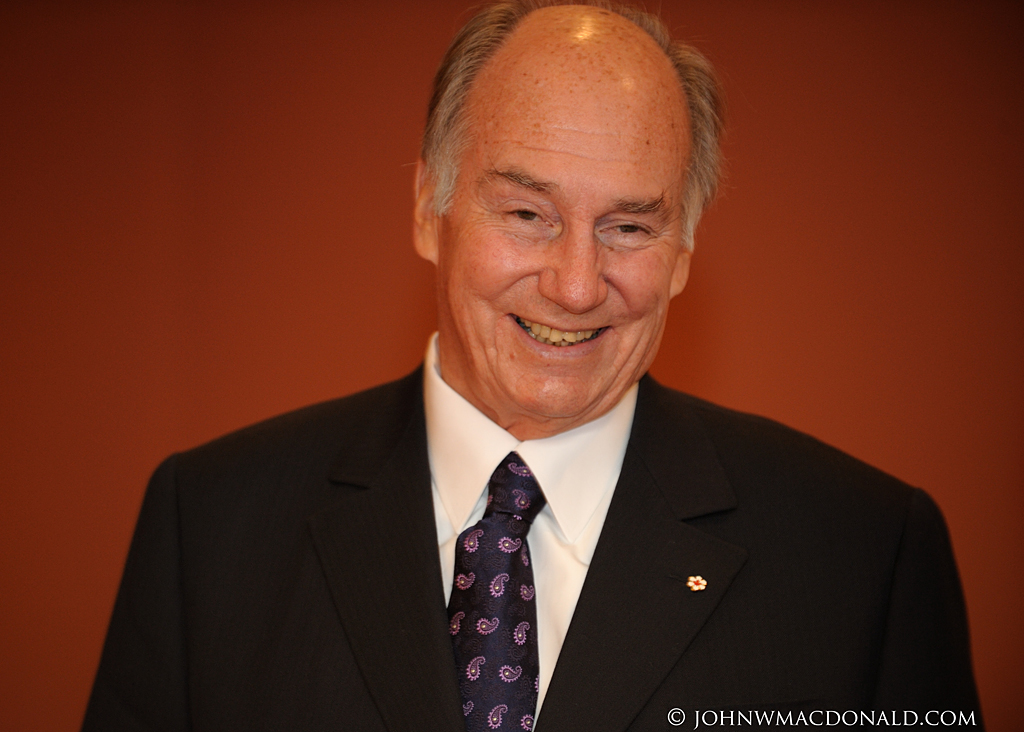
His Highness the Aga Khan, 49th Ismaili Imam and direct descendant of the Prophet Muhammad pictured at Rideau Hall on October 7, 2010, where he was received by Canada’s 28th Governor General, His Excellency David Johnston. Photo: John MacDonald, Ottawa. Copyright.
Peter Mansbridge: You must love Canada – you keep coming back here.
Aga Khan: I do.
PM: What is the quality that you most admire about this country?
AK: I think a number of qualities. First of all, it’s a pluralist society that has invested in building pluralism, where communities from all different backgrounds and faiths are happy. It’s a modern country that deals with modern issues, not running away from the tough ones. And a global commitment to values, to Canadian values, which I think are very important.
PM: Let’s talk about that a little bit, because I wonder whether your confidence in Canada has in any way been shattered a little bit in these past few years, especially since 9/11. There have been tensions in this country, as there have been in many other Western countries, between Muslim and non-Muslim societies – on any number of levels, on both sides, about history, religion, tradition and integration within society. How much has that concerned
you?
AK: It concerns me and at the same time it doesn’t, in the sense that, to me, building and sustaining a pluralist society is always going to be a work in progress. It doesn’t have a finite end. And so long as there is national intent, civic intent to make pluralism work, then one accepts that it’s a work in progress.
PM: Let me go a little deeper on that, because it raises a question you have often raised, and that’s the issue of ignorance. You reject the theory of a clash of civilizations, or even a clash of religions. You believe there’s a clash of ignorance here, on both sides of that divide. And you’ve felt that way for a long time. I was looking through the transcripts of an interview you gave in the 1980s in Canada where you were warning the West that it had to do a better job in trying to understand Islam. That clearly hasn’t happened.
AK: No, it hasn’t happened. A number of friends and people in important places have tried to contribute to solving that problem, but it’s a long-established problem. It’s going to take, I think, several decades before we reach a situation where the definition of an educated person includes basic understanding of the Islamic world. That hasn’t been the case. And the absence of that basic education has caused all sorts of misunderstandings.
PM: What’s been the resistance?
AK: I think it’s essentially historic. I think that Judeo-Christian societies have developed their own education, and basic knowledge of the Islamic world has simply been absent. Look at what was required for an education in the humanities; for example, I was a student in the U.S. and education on the Islamic world was absent.
PM: Is this a one-sided clash of ignorance?
AK: No, I think there is ignorance on both sides, and I think very often there’s confusion. I think more and more there has been confusion between, for example, religion and civilization. And that’s introducing instability in the discussion, frankly. I would prefer to talk about ignorance of the civilizations of the Islamic world rather than ignorance just on the faith of Islam.
PM: What we’ve witnessed in the last couple of years, not just in this country but in other Western countries as well, is what we call “homegrown terror,” where you see young Muslim men – born in the West, educated in the West – moving towards a fundamentalist view, a militant view of Islam. Why is that happening?
AK: There is without any doubt a growing sense amongst Muslim communities around the world that there are forces at play that it doesn’t control, that views the Muslim world with, let’s say, unhappiness or more. I would simply say, however, that if you analyze the situation I don’t think you can conclude that all Muslims from all backgrounds are part of that phenomenon. Secondly, if you go back and look at the communities where this is common, you will find that there’s a long-standing unresolved political crisis in the community. It’s very, very risky, I think, to interpret these situations as being specific to the faith of Islam. It is specific to peoples, sometimes ethnic groups, but it’s not specific to the face of Islam.
PM: That must really concern you. Your followers see you as a direct descendant of the Prophet Muhammad, the same prophet that some of these minority fundamentalist militant groups hold up and claim as the reason they’re doing the acts they’re doing.
AK: Again, I think one has to go back and say, “What is the cause of this situation?” With all due respect, if you look at the crisis in the Middle East, that crisis was born at the end of the First World War. The crisis in Kashmir was born through the liberation of the Indian continent. These are political issues originally; they’re not religious issues. You can’t attribute the faith of Islam to them. I think the second point I would make is this tendency to generalize Islam. There are many different interpretations of Islam. As a Muslim, if I said to you that I didn’t recognize the difference between a Greek Orthodox or a Russian Orthodox or a Protestant or a Catholic, I think you’d say to me, “But you don’t understand the Christian world.” Let me reverse that question.
PM: Canada’s role in Afghanistan is well-known, has been since 9/11. So is the Aga Khan Foundation, which is in there in a big way in development matters. The question is simple, really: with all the help that’s been given to Afghanistan, why is the Taliban resurging? Not only in numbers, but in popularity as well. Why is that happening?
AK: I think there are a number of reasons, but the one that I would put forward as the most immediate is the slow process of reconstruction.There was a lot of hope that once there was a regime change and a new government and the political process had been completed, the quality of life would change. It hasn’t changed quickly enough. It’s taken much more time than I think many of us had hoped to get to isolated communities in Afghanistan and improve their quality of life. It’s an organizational problem. Even amongst the donor countries there have been differences of opinion. The management of the drug problem has not been a united effort by any means. So there are a number of things that have slowed up the process. And there are still acute pockets of poverty in Afghanistan: people who don’t have enough food, people who don’t have access to any education, any health care. It is clear this sort of frustration causes bitterness and the search for other solutions.
PM: Is there time to turn it around? Because you get a sense that the pendulum has swung back considerably in the last year or so. There’s this growing sense of frustration among the Canadian people and a belief that it’s a war that cannot be won.
AK: I would beg to differ on that. I think what we’re seeing in Afghanistan, at least from my own network of activities, is an increasingly visible two-speed process, where in the north and the west you’re beginning to see quantifiable change. In the east and the south you’re not seeing that. Two-speed change is going to have to be managed with great care, but it’s not a good reason to give up by any means.
PM: Can you do both at the same time? That’s the debate in Canada: to run a military operation – talking specifically about the south – while trying to introduce aid and development in an area that is not secure.
AK: It’s very difficult to do, but necessary. Every step counts. Certainly in areas where there’s insecurity, I think the availability for populations to participate in these development activities does go down when quality of life changes. And I believe the same thing with regard to the drug problem.
PM: How much of the problem in Afghanistan is a result of the decision on the part of the Americans and the British to move into Iraq?
AK: Very substantial indeed. The invasion of Iraq was something which has mobilized what we call the Imamat – the community of Muslims around the world. Every Muslim that I have ever talked to has felt engaged by this.
PM: On what level?
AK: Baghdad is one of the great historic cities of the Islamic world. Iraq is not a new country; it’s part of the history of our civilization. It’s been a pluralist country and has produced great philosophers, great historians, great scientists. Reverse the question again. What would the Christian world think if a Muslim army attacked Rome? I think there would be a general reaction in the Christian world, not just an Italian reaction.
PM: But it seems that even in the Muslim world, that invasion has caused major divisions – the clash inside Islam itself, between Shia and Sunni.
AK: That was entirely predictable. Entirely predictable. What you are effectively doing is replacing a Sunni minority government in a country that has a Shia demographic majority. And again, what would happen – I’m sorry to come back to this, but it’s important – if a Muslim army went in to Northern Ireland and replaced one Christian interpretation by another? Imagine the fallout that that would cause in the Christian world itself.
 
PM: So what happens now? Can Iraq be put back together? And who would be doing the putting back together?
 
AK: I think that’s a very, very difficult question, and I would not want to predict the answer. Because I think that the whole process of change in Iraq has regional dimensions which have got to be managed. They’re not national dimensions in Iraq. Those regional dimensions also were predictable, let’s be quite frank about it. I think they’re going to need to be managed with very, very great care.
 
PM: Is the answer, as some suggest, the splitting of it into three regions with the main two combatants, the Shia and the Sunnis, actually separated by borders?
AK: That’s really, I think, an issue where the leaders of the three communities have got to agree or not. In my life, in the past fifty years, I have been uncomfortable with the creation of unviable states. So I would ask this question: if you did do that, what components of Iraq would be stable, viable states in the future?
PM: Who’s showing leadership in this world right now in terms of the major global issues? Who do you look to as a leader, whether it’s a political leader or not?
AK: I think there are a number of people in the U.N. system who’ve shown leadership, who have shown balanced judgment on these issues. Because when all is said and done, it’s the balance of the judgment that counts. And it’s understanding the issues. I think, amongst others, Kofi Annan has been remarkable in his understanding of the issues. He’s also had a team of people around him who are very good.
PM: It’s quite a condemnation though of the political leaders of our generation that you don’t point to one of them, no matter which side of the divide we talked about earlier. You don’t see one there?
AK: I’m looking at the regions of Africa, Central Asia, and I’m asking myself within this context who’s having the greatest influence. I think that certainly the U.N. Development Program…I think the World Bank and Jim Wolfensohn changed direction very significantly and dealt with real human issues and has done a wonderful job.
PM: Some people suggest that there’s been a movement in terms of real leadership away from governments to private foundations, philanthropic organizations – yours being one, the Gates Foundation, and you can name a number of them. Do you see that happening? Is that a good thing?
AK: I see it happening, and I welcome it wholeheartedly. Because what we’re talking about, I think, is accelerating the construction of a civil society. I personally think that civil society is one of the most urgent things to build around the world. Because one of the phenomena you see today is the number of countries where governments have been unstable. Progress is made where there’s been a strong civil society, and that’s a lesson that I think all of us have to learn. My own network is immensely committed to that. And so what the Gateses and others are doing is providing new resources, new thoughts to create civil society. Whether it’s in health care or education, it’s the combined input which is so exciting and so important.
PM: We touched briefly earlier on the new Global Centre for Pluralism, which will be established here in Canada through the Aga Khan Foundation and the people of Canada through the Government of Canada. What is your hope for that? What do you see that doing, accomplishing?
AK: I hope that the centre will learn from the Canadian history of pluralism, the bumpy road that all societies have in dealing with pluralist problems, the outcomes, and offer the world new thoughts, new ways of dealing with issues, anticipating the problems that can occur. Because in recent years I think we’re seeing more and more that no matter what the nature of the conflict, ultimately there is a rejection of pluralism as one of the components. Whether it’s tribalism, whether it’s conflict amongst ethnic groups, whether it’s conflict amongst religions, the failure to see value in pluralism is a terrible liability.
PM: Why Canada?
AK: Because I think Canada is a country that has invested in making this potential liability become an asset. I think that Canada has been perhaps too humble in its own appreciation of this global asset. It’s a global asset. Few countries, if any, have been as successful as Canada has, bumpy though the road is. As I said earlier, it’s always going to be an unfinished task.
PM: Next year is your golden jubilee: fifty years. What’s your – I was going to say what’s your dream for the world in that year, but I guess dreams are dreams. What’s your realistic hope?
AK: In areas of the world which are living in horrible poverty, I’d like to see that replaced by an environment where people can live in more hope than they’ve had. I’d like to see governments that produce enabling environments where society can function and grow rather than live in the dogmatisms that we’ve all lived through, and which I think have been very constraining. And I’d like to see solid institutional building, because, when all is said and done, societies need institutional capacity.
PM: Those are grand hopes. I’m sure they’re shared by many. How realistic do you think it is that we can achieve anything like that?
AK: I think we can achieve a lot of that. I think the time frame is what we don’t control. I remember in the mid-fifties reading about countries in the developing world being referred to as basket cases. Fifty years later those are some of the most powerful countries in the world -  enormous populations. They’re exporting food when fifty years ago we were told they’d never be able to feed themselves. They had an incredible technology deficit fifty years ago. Today they’re exporting technology, homegrown technology. So I think there are a number of cases out there where we can say what we don’t control is the time factor. But society does have the capability to make those changes.
PM: So there is reason for hope.
AK: I believe so, God willing.
Postscript by Peter Mansbridge: As inspiring as his message was, the lasting memory I take from that day was more personal. It was the beaming face of Sherali Najak standing next to the Aga Khan for that special photograph he had so wanted to get. The man who regularly bosses Don Cherry around looked pretty tame all of a sudden.
Interview Material © Canadian Broadcasting Corporation. Reprinted by Simerg permission of Random House Canada.

Monday, December 14, 2009

Copenhagen is about Climate Justice

Climate Justice assures every one in the long haul that one can continue living and breathing regardless of being rich or poor. Protecting the environment is the right thing to do; indeed it is a sacred duty of every human. As an individual or a nation we cannot shut ourselves in a bubble; either we suffer the damage together or save the environment for all. None of us can live in silos.

Continued: http://wisdomofreligion.blogspot.com/2009/12/copenhagen-is-about-climate-justice.html
~~~

Monday, November 30, 2009

Mike Ghouse to Speak at Parliament of Worlds Religions

DALLAS – (November 28, 2009) – Mike Ghouse, board member of The Memnosyne Foundation, has been invited to speak at the Council for a Parliament of the World Religions in Melbourne, Australia. Co-Founder and President of The Memnosyne Foundation, Mary Ann Thompson-Frenk, made the announcement recently.

Continued - http://wisdomofreligion.blogspot.com/2009/11/mike-ghouse-to-speak-at-parliament-of.html

~~~~

Sunday, November 22, 2009

Eid-al-Adha - What is a sacrifice

WARNING: If you do not believe in Ijtihad, please do not read the following. If you are binary Muslim who sees everything in terms of Halaal/Haraam, the following notes are not for you.

http://worldmuslimcongress.blogspot.com/2009/11/eid-al-adha-what-is-sacrifice.html

Dr. Lalani thinks aloud, but makes a valid point about Sacrifice.

We should be open to his idea, and as Muslims we should debate it and see the merits and alternatives for the same. It does not mean giving up eating the meat, it simply means finding the alternatives for the present day massive animal slaughter on the day of Eid.

The idea of sacrifice he has explained - of giving up things that are dear to one is meaningful. I request the Muslims who are free to think to propose a full idea on how to handle the symbolic sacrifice Muslims make on the day of Eid-al-Adha.

Two articles below talk about the the 300,000 animals being sacrficed by Hindus in Nepal and on Thanksgiving Day, we probably would slaughter more than 20 Million turkeys, that is one turkey for every 15 Americans.

That is our food..... think from a survival point of view...

Look at this way, the wheat we grind to flour and eat kills the future of wheaties from that seed of wheat we kill. The veggies we eat have life that we shorten. If we do not kill the wheat, it keeps growing and reseeding....

Every veggie has life too. We are part of it and animals are part of it. If no one kills the animals and veggies, and no animal eats other animal... there will be a huge problem.

Religions were wise to go along with the system of nature... we are each others sustenance.
Sounds bad, but what are the choices? Why show prejudice towards Veggies and not towards animals? No matter what you eat, you are killing the continuance of the life of that item.

Mike Ghouse
http://www.worldmuslimcongress.com/
~ ~~ ~ ~ ~~

I am a Muslim, and not just a MINO (Muslim in Name Only) and I admit I could do better in practice of my religion.

There is one Islamic ritual with which I have a great deal of trouble and that is Kurbani. I have never slaughtered an animal myself but I have seen a goat being dragged to the spot of sacrifice on Eid-alAdha and I have seen how desperately the goat struggles and resists. It is quite obvious that the animal knows what is in store for it (it is uncanny). And I have seen its throat being cut and its being exsanguinated and a painful death superveing slowly and inexorably.

I hold Prophets Ibrahim and Mohammad (praise be on them both) in highest reverence and I am not a vegetarian (although I wish I could have been). I also do not question God's commandment to Ibrahim to show his devotion to Allah by going through with the sacrifice of his only son at that time, (this must have been before the birth of Isaac, PBUH).

However, could it be that God's Commandment to sacrifice was for to him to give whatever it was that was most dear or his very valuable possession. In those days, livestock was a measure of wealth and meat was not pletiful so that protein deficiency must have been endemic, especially among the poor (the majority). Alll those facts pointed to a living animal as logical possesiion fit for sacrifice.

I performed Umra in December of 1993 and read an 'official' piece of Saudi government literature provided to the pilgrims (including Hajj). It clearly stated that money donation can emphatically substitute for animal sacrifice and that meat was allowed to Muslims but not mandated by our great faith.

I am a physician (now retired) and I have no doubt that dairy products (esp cheese) and eggs (unfertilized) can definitely furnish all the protein a human needs and in fact even those may not be indispensable (lentils and legumes have plenty of the so called first class proteins).
Jews used to practice Qurbani following the example of Abrham/Ibrahim (PBUH) until the destruction in 570 b.c. of the First Temple and - perhaps - until the destruction of the Second Temple in 70 AD but they seem to have completely given up the practice since the diaspora. And still, we include them - and Christians - among the believers. Europeans used to sacrifice animals to Jupiter and Apollo and Minerva etc. but quit that practice when Christianity replaced idol-worshipping, polytheistic Homeric religion ( 'Hellenism'). Could we at least heed the kernel of their argument against performing anuimal sacrifice without becoming vegetarians?

Astaghfirullah!

Inayat Lalani
~~~~~~~~~~

'World's biggest animal sacrifice' in Nepal

By Claire Cozens
Agence France-Presse

KATHMANDU, Nepal—Thousands of Hindu devotees have flocked to a village in Nepal ahead of the planned sacrifice of more than 300,000 animals in a ceremony condemned by animal rights activists, including French actress Brigitte Bardot.

Priests are preparing for the slaughter of more than 15,000 buffaloes and 300,000 birds, goats, and sheep during the event, which starts Tuesday and is thought to be the biggest ritual sacrifice anywhere in the world.

Every five years, the village of Bariyapur, near Nepal's southern border with India, hosts this religious festival dedicated to Gadhimai, the Hindu goddess of power.

"Thousands of people from Nepal and India have already begun arriving and preparations for the festival are in full swing," Mangal Chaudhary Tharu, the main priest at the Gadhimai temple, told AFP.

He said visitor numbers were expected to be higher this year because it is the first such ceremony since the end of Nepal's conflict in 2006 and he vowed to go ahead with the sacrifice despite the protests.

Tharu, the fourth generation of his family to serve as a priest at the temple, said he expected more than a million people to attend, over half from India, where many states have banned animal slaughter for religious purposes.

Nepal's government has refused to put a stop to what it says is a centuries-old religious tradition, and has pledged 4.5 million rupees (60,000 dollars) in funding.

"People have deep faith in the goddess and they believe that sacrificing animals will bring them good luck and prosperity for their families," said Tharu.

"I don't think the mood will be spoiled by the animal rights campaigners. They have the right to raise their concerns and we have the right to continue with our age-old tradition."
Armed police have been deployed to keep the peace and authorities have banned alcohol during the festival, which begins with the ritual sacrifice of two wild rats, a rooster, a pig, a goat, and a lamb.

The meat is distributed to the devotees and to local people, while contractors bid for the animal hides—making the slaughter a lucrative venture for the local community.

But the ceremony has been strongly opposed by animal rights campaigners, who are demanding an end to what they say is senseless cruelty.

The cause is supported by the well-known Indian animal rights activist Maneka Gandhi and by Bardot, a veteran campaigner who this month wrote to Nepal's president urging him to put a stop to the festival.

"Thousands of terrified buffaloes will have their heads cut off by drunken devotees," she wrote.

"Honorable president, I have dedicated my life to protect animals and the best gift I could receive for this lifelong struggle would be the announcement of the stopping of ritual sacrifice."

Pramada Shah, director of pressure group Animal Nepal, says the campaign has won strong support both in Nepal and abroad, although she accepts it faces an uphill struggle in this deeply conservative, majority-Hindu nation.

"In a country like Nepal it is very difficult to raise these issues," she told AFP.
"The idea of animal rights is very new here and people are so used to sacrifices, even well-educated people are resistant to change. There is a lot of work to be done here, but slowly, progress is being made."

She says attitudes toward ritual slaughter are beginning to change in Nepal, a view shared by cultural expert Chunda Bajracharya.

"Belief in these ancient rituals is deep rooted in our society," said Bajracharya, professor of cultural studies at Kathmandu's Tribhuvan University.

"But there is evidence that animal sacrifices are becoming less popular, especially in urban areas, where people are instead choosing to 'sacrifice' eggs or coconuts.
"Mindsets are gradually changing."

Shared by Hasni Essa
~~~~~~~~~~~~~~~~~~~~

Op-Ed Contributor
Animal, Vegetable, Miserable
http://www.nytimes.com/2009/11/22/opinion/22steiner.html?_r=1&th=&emc=th&adxnnlx=1258906532-O4jMyLUNdeeDH51oBuwxrA&pagewanted=all
Karen Barbour

Related
Times Topics: VeganismLATELY more people have begun to express an interest in where the meat they eat comes from and how it was raised. Were the animals humanely treated? Did they have a good quality of life before the death that turned them into someone’s dinner?

Some of these questions, which reach a fever pitch in the days leading up to Thanksgiving, pertain to the ways in which animals are treated. (Did your turkey get to live outdoors?) Others focus on the question of how eating the animals in question will affect the consumer’s health and well-being. (Was it given hormones and antibiotics?)

None of these questions, however, make any consideration of whether it is wrong to kill animals for human consumption. And even when people ask this question, they almost always find a variety of resourceful answers that purport to justify the killing and consumption of animals in the name of human welfare. Strict ethical vegans, of which I am one, are customarily excoriated for equating our society’s treatment of animals with mass murder. Can anyone seriously consider animal suffering even remotely comparable to human suffering? Those who answer with a resounding no typically argue in one of two ways.

Some suggest that human beings but not animals are made in God’s image and hence stand in much closer proximity to the divine than any non-human animal; according to this line of thought, animals were made expressly for the sake of humans and may be used without scruple to satisfy their needs and desires. There is ample support in the Bible and in the writings of Christian thinkers like Augustine and Thomas Aquinas for this pointedly anthropocentric way of devaluing animals.

Others argue that the human capacity for abstract thought makes us capable of suffering that both qualitatively and quantitatively exceeds the suffering of any non-human animal. Philosophers like Jeremy Bentham, who is famous for having based moral status not on linguistic or rational capacities but rather on the capacity to suffer, argue that because animals are incapable of abstract thought, they are imprisoned in an eternal present, have no sense of the extended future and hence cannot be said to have an interest in continued existence.

The most penetrating and iconoclastic response to this sort of reasoning came from the writer Isaac Bashevis Singer in his story “The Letter Writer,” in which he called the slaughter of animals the “eternal Treblinka.”

The story depicts an encounter between a man and a mouse. The man, Herman Gombiner, contemplates his place in the cosmic scheme of things and concludes that there is an essential connection between his own existence as “a child of God” and the “holy creature” scuffling about on the floor in front of him.

Surely, he reflects, the mouse has some capacity for thought; Gombiner even thinks that the mouse has the capacity to share love and gratitude with him. Not merely a means for the satisfaction of human desires, nor a mere nuisance to be exterminated, this tiny creature possesses the same dignity that any conscious being possesses. In the face of that inherent dignity, Gombiner concludes, the human practice of delivering animals to the table in the form of food is abhorrent and inexcusable.

Many of the people who denounce the ways in which we treat animals in the course of raising them for human consumption never stop to think about this profound contradiction. Instead, they make impassioned calls for more “humanely” raised meat. Many people soothe their consciences by purchasing only free-range fowl and eggs, blissfully ignorant that “free range” has very little if any practical significance. Chickens may be labeled free-range even if they’ve never been outside or seen a speck of daylight in their entire lives. And that Thanksgiving turkey? Even if it is raised “free range,” it still lives a life of pain and confinement that ends with the butcher’s knife.

How can intelligent people who purport to be deeply concerned with animal welfare and respectful of life turn a blind eye to such practices? And how can people continue to eat meat when they become aware that nearly 53 billion land animals are slaughtered every year for human consumption? The simple answer is that most people just don’t care about the lives or fortunes of animals. If they did care, they would learn as much as possible about the ways in which our society systematically abuses animals, and they would make what is at once a very simple and a very difficult choice: to forswear the consumption of animal products of all kinds.

The easy part of this consists in seeing clearly what ethics requires and then just plain doing it. The difficult part: You just haven’t lived until you’ve tried to function as a strict vegan in a meat-crazed society.

What were once the most straightforward activities become a constant ordeal. You might think that it’s as simple as just removing meat, eggs and dairy products from your diet, but it goes a lot deeper than that.

To be a really strict vegan is to strive to avoid all animal products, and this includes materials like leather, silk and wool, as well as a panoply of cosmetics and medications. The more you dig, the more you learn about products you would never stop to think might contain or involve animal products in their production — like wine and beer (isinglass, a kind of gelatin derived from fish bladders, is often used to “fine,” or purify, these beverages), refined sugar (bone char is sometimes used to bleach it) or Band-Aids (animal products in the adhesive). Just last week I was told that those little comfort strips on most razor blades contain animal fat.

To go down this road is to stare headlong into an abyss that, to paraphrase Nietzsche, will ultimately stare back at you.

The challenges faced by a vegan don’t end with the nuts and bolts of material existence. You face quite a few social difficulties as well, perhaps the chief one being how one should feel about spending time with people who are not vegans.

Is it O.K. to eat dinner with people who are eating meat? What do you say when a dining companion says, “I’m really a vegetarian — I don’t eat red meat at home.” (I’ve heard it lots of times, always without any prompting from me.) What do you do when someone starts to grill you (so to speak) about your vegan ethics during dinner? (Wise vegans always defer until food isn’t around.) Or when someone starts to lodge accusations to the effect that you consider yourself morally superior to others, or that it is ridiculous to worry so much about animals when there is so much human suffering in the world? (Smile politely and ask them to pass the seitan.)

Let me be candid: By and large, meat-eaters are a self-righteous bunch. The number of vegans I know personally is ... five. And I have been a vegan for almost 15 years, having been a vegetarian for almost 15 before that.

Five. I have lost more friends than this over arguments about animal ethics. One lapidary conclusion to be drawn here is that people take deadly seriously the prerogative to use animals as sources of satisfaction. Not only for food, but as beasts of burden, as raw materials and as sources of captive entertainment — which is the way animals are used in zoos, circuses and the like.

These uses of animals are so institutionalized, so normalized, in our society that it is difficult to find the critical distance needed to see them as the horrors that they are: so many forms of subjection, servitude and — in the case of killing animals for human consumption and other purposes — outright murder.

People who are ethical vegans believe that differences in intelligence between human and non-human animals have no moral significance whatsoever. The fact that my cat can’t appreciate Schubert’s late symphonies and can’t perform syllogistic logic does not mean that I am entitled to use him as an organic toy, as if I were somehow not only morally superior to him but virtually entitled to treat him as a commodity with minuscule market value.

We have been trained by a history of thinking of which we are scarcely aware to view non-human animals as resources we are entitled to employ in whatever ways we see fit in order to satisfy our needs and desires. Yes, there are animal welfare laws. But these laws have been formulated by, and are enforced by, people who proceed from the proposition that animals are fundamentally inferior to human beings. At best, these laws make living conditions for animals marginally better than they would be otherwise — right up to the point when we send them to the slaughterhouse.

Think about that when you’re picking out your free-range turkey, which has absolutely nothing to be thankful for on Thanksgiving. All it ever had was a short and miserable life, thanks to us intelligent, compassionate humans.


Gary Steiner, a professor of philosophy at Bucknell University, is the author of “Animals and the Moral Community: Mental Life, Moral Status and Kinship.”


~~~~~~~~~~~~~~~~~~~~~

Click and comment: http://worldmuslimcongress.blogspot.com/2009/11/eid-al-adha-what-is-sacrifice.html#comments

~~~~~

Thursday, November 19, 2009

Muslim countries seek blasphemy ban

A good debate is warranted on the issue. I am inclined to support the freedom of speech, hoping civility would ultimately prevail. Rules should be made for the general good of the population and not to address the exceptions, as the majority of the people in every group are moderate, law abiding, easy to get along and practice live and let live way of life. However, we cannot be blind to many a laws that have been the catalyst in bringing about a positive change.

Continued at:
http://wisdomofreligion.blogspot.com/2009/11/muslim-countries-seek-blasphemy-ban.html

Mike Ghouse
~~~

Wednesday, November 18, 2009

Allahu Akbar by Matthew Moes

I wrote an article about Allahu Akbar's significance, which I will publish after it is published in the news paper. Mathew commented on my face book and shared this wonderful poem. Allahu Akbar is about humility and not arrogance or incitement.

By Matthew Moes
YZK Institute for Islamic Scholarship and Research
Richardson.

Allahu Akbar - God is Great
Words I say
When I turn from the world to pray
Words I say
When I bow down
Words I say
When I put my face to the ground
Words I say
When I lift my head from the floor

Words that signal a return
Words that prioritize
Words of humility
Words of attribution

Tremendous Words

Words not to be abused by madmen
Words not to be mocked by media men
Words not to be perverted by terrorism
Words not to be distorted by charlatans

Words of reverence
Words of faith
Words of exalting joy

Words sung out in the call to prayer
Words to celebrate breaking the month-long fast
Words to commemorate the sacrifice of Abraham
Words to consecrate the life that becomes our food
Words for the funeral prayer, the final salute

Words of salvation
Words of adoration
Words of elation
Words of liberation

Allahu Akbar - God is Great!
Allahu Akbar - God is Greater!
Allahu Akbar - God is Greatest!

Beautiful Words
Words, just words, and yet
Powerful Words!
Words only fit for Him!
# # #

Tuesday, October 13, 2009

Chandra Muzaffar on Pluralism & Ijtihad

http://worldmuslimcongress.blogspot.com/2009/10/chandra-muzaffar-on-pluralism-ijtihad.html

I subscribe to Dr. Muzaffar’s views and have taken up the initiative to bring about a new dimension in our understanding of Islam in the context of the ever universalizing world. A few abstracts followed by the interview. Mike Ghouse

"The fixation of many Muslims with fiqh, with the externalities of religion in terms of rituals or with Arabic linguistic terms and culture, completely negates what I regard as Islam’s inherent universality."

Sadly, this project has not gone very far, although in the recent past people like Abul Kalam Azad and Iqbal in India, and Malik Bennabi in North Africa, did argue along these lines, even though they may not have termed this as ijtihad as such, perhaps because,

Given the traditionalist ulema’s understanding of what qualifies a person to be called a mujtahid, these people (Abul Kalam Azad, Iqbal, Malik Bennabi) would have been automatically disqualified by them.

We have also tried to promote intra-Muslim dialogue, between progressive Islamic scholars and the traditional, or ‘orthodox’, groups, but here, too, we have failed. One reason for this is that the latter are simply not open to dialogue with the former, whom they consider as having deviated from what they regard as true Islam.
#

Chandra Muzaffar on Pluralism & Ijtihad
By Yogi Sikand.

Chandra Muzaffar is Malaysia’s best-known public intellectual. He has written widely on questions related to Islam, inter-faith relations and liberation theology, issues that he discusses in this interview with Yoginder Sikand.

Q: Much of your writing focuses on a critique of capitalism and consumerism, or what you very aptly term as ‘moneytheism’, which you contrast with the monotheism of Islam. How do you see Muslim scholars dealing with these issues?

A: Unfortunately, what is in some circles called ‘Islamic Economics’ has not sufficiently critiqued capitalism and the consumerist ethos. In fact, many of those associated with the ‘Islamic Economics’ project have simply tried to apply a so-called ‘Islamic’ gloss on capitalism. If at all those associated with the ‘Islamic Economics’ project critique consumerism, which is such a deeply-rooted phenomenon globally, including in predominantly Muslim countries, it is only at a very general level, in the form of statements to the effect that it is incompatible with Islam, or appeals for balance, restraint and moderation. But this does not go along with any rigorous analysis of economic structures that generate consumerism in the first place. I don’t know of any well-known writers associated with the ‘Islamic Economics’ project who have done this in a sufficient manner. Rather, their focus tends to be more on the technical aspects, such as the ban on interest, interest-free banking and discussions about disallowing the production of things considered to be haraam.

I think one reason why these scholars have not sufficiently critiqued consumerism and capitalism is that they tend not to discuss issues that are not already written about in the fiqh tradition. Then, the references in the Quran that could be interpreted as condemning consumerism are of a general sort, and are not, in most cases, specific, and so these scholars have not gone beyond these generalities. Further, many of these scholars lack sufficient sensitivity to class issues, and so their project ultimately tends to work in favour of the powers that be, the ruling classes, their formulations being easily co-opted into the existing capitalist framework. A good instance of this is what are fashionably called ‘Islamic banks’.

Q: Another major concern in your writings relates to the concept of ijtihad, which you use to argue the case for reformulating traditional Muslim understandings on a host of issues. How do you envisage ijtihad in relation to vital issues of contemporary import, such as gender relations or relations between Muslims and others?

A: Generally, ijtihad, if at all it is discussed by Muslim scholars, is in the context of the nitty-gritty of fiqh formulations, but, personally, I think it should also apply to a whole range of other issues, including our world-views, the way we understand our religion and its relation to other faiths, inter-faith relations, issues of gender, and so on. Sadly, this project has not gone very far, although in the recent past people like Abul Kalam Azad and Iqbal in India, and Malik Bennabi in North Africa, did argue along these lines, even though they may not have termed this as ijtihad as such, perhaps because, given the traditionalist ulema’s understanding of what qualifies a person to be called a mujtahid, these people would have been automatically disqualified by them.
Q: A major issue that ‘progressive’ and ‘modernist’ Muslim scholars are today focusing on is the need to go beyond traditional fiqh formulations, and, indeed, the very tendency to understand every issue in terms of the fiqh tradition. How do you relate to this?

A: Personally, I feel that we need to emancipate ourselves from the traditional fiqh methodology. The moment you view something from the traditional fiqh point of view, or look at it as a ‘Muslim’ issue, rather than one of universal human significance, you limit your own understanding, transforming it into something narrowly communal, which, as a Muslim, I see as going against the fundamental universality of Islam. The fixation of many Muslims with fiqh, with the externalities of religion in terms of rituals or with Arabic linguistic terms and culture, completely negates what I regard as Islam’s inherent universality.

Frankly, I am increasingly despondent about the marked tendency to see and interpret things from a narrow ‘Muslim’ or so-called ‘Islamic’ point of view, and this applies to new fads such as ‘Islamic Economics’ or ‘Islamic food’ or whatever. If one is looking for solutions to problems through traditional understandings of religion—any religion for that matter—at the end of the day, if one’s mindset is not universal, the quest is utterly futile. I think one of the most basic tasks before us today is to evolve universal understandings of spirituality that go beyond, and transcend, religion and communal barriers, as traditionally conceived. Sadly, we are in a situation where religion, in the sense of labels, language, dogmas and rituals, seems to be of more practical importance than God. That is to say, even if we may not recognize it, we worship our own particular religions in place of God. This is precisely what many Muslims tend to do with their exclusivity, their narrow approach to fiqh, their obsession with rituals and laws which they imagine to be the shariah, and, indeed, what amounts to the very idolization of the shariah.

Q: You have been at the forefront of seeking to promote inter-religious dialogue between Muslims and others, in Malaysia as well as internationally. How do you reflect on your experiences in this regard?

A: In Malaysia we have tried to do this sort of thing, but the problems are daunting and we have not been very successful. We have also tried to promote intra-Muslim dialogue, between progressive Islamic scholars and the traditional, or ‘orthodox’, groups, but here, too, we have failed. One reason for this is that the latter are simply not open to dialogue with the former, whom they consider as having deviated from what they regard as true Islam. If at all they are interested in any sort of dialogue, it is simply in order to impose their own perspectives on others. This can hardly be called dialogue, in the true sense of the term. They are simply too-closed minded, whereas dialogue presupposes that dialogue partners should be open-minded and amenable to listening to other views. Otherwise, there is no point in even attempting to dialogue.
As for inter-faith dialogue, I, as a Muslim, believe that there is much that Muslims need to set in order before they can genuinely dialogue with people of other faiths. Certain deep-rooted, traditionally-held notions, shared by millions of Muslims, must be recognized as being gravely inimical to genuine inter-faith dialogue, such as common assumptions about terms such as kafir and jihad, the alleged ‘impurity’ of non-Muslims, the notion of Muslim supremacism and the belief that all non-Muslims are ‘enemies of God’ or are doomed to perdition in hell. We need to revise our understandings of these issues if we are at all to be able to proceed with the task of inter-religious dialogue and solidarity. Many of these understandings emerged after the demise of the Prophet, at a time of Muslim political expansionism. These were later reinforced in the face of Muslim political losses and traumas in the wake of the Mongol onslaught, the Crusades, and, then, European colonialism, and, now, Western, particularly American, imperialism. We need to re-evaluate our views on these matters, and bring them in line with proper Quranic understandings, which I believe to be just and egalitarian.

Chandra Muzaffar can be contacted on cmuzaffar@gmail.com
Yoginder Sikand works with the Centre for the Study of Social Exclusion and Inclusive Social Policy at the National Law School, Bangalore.

If you wish to comment:
http://worldmuslimcongress.blogspot.com/2009/10/chandra-muzaffar-on-pluralism-ijtihad.html#comments

Friday, October 9, 2009

Fighting Domestic Violence

MUSLIM COMMUNITY CENTER FOR HUMAN SERVICES
7600 Glenn View Dr. Richland Hills, TX 76016
http://www.mcc_hs.org/

Fighting Domestic Violence
New book is a study of domestic violence in a cross-cultural context

Arlington, TX – October 1, 2009 – Domestic violence is a global phenomenon occurring among people of all races, ages, social economic status, educational, and religious backgrounds. Advocate M. Basheer Ahmed, M.D., believes that in order to develop culturally appropriate interventions in addressing this issue, it is critical to understand this subject within a cross-cultural context. In relation to this, he presents Domestic Violence Cross Cultural Perspective, a comprehensive and eye-opening book released through Xlibris.

Family roles, values, customs, and expectations are deeply rooted within a person’s culture and religious traditions. Many community and religious leaders are not familiar of the incidence of domestic violence among immigrant population and lack the knowledge of the effect of domestic violence on the victims, their children, the legal implications and the resources available for them.

In its opening chapter, Domestic Violence Cross Cultural Perspective summarizes various topics discussed related to psychodynamics of abuse, cross-cultural, Islamic, Jewish and Hindu perspective. The other topics covered are effects of domestic violence on children and the legal aspects of domestic violence. The last chapter gives a detailed description of the development of a domestic violence program for the immigrant community.

Written for health professionals, religious, and community leaders in a simple language, Domestic Violence Cross Cultural Perspective addresses the aspects of domestic violence from different cultural and religious orientations and suggests strategies to help victims and perpetrators.

About the Author
M. Basheer Ahmed, M.D., is the Chairman and the Executive Director for the Muslim Community Center for Human Services, North Texas. He obtained his medical degree from Dow Medical College in Karachi, Pakistan, and completed postgraduate psychiatric studies at Glasgow University in Scotland. He is board certified by the American Board of Psychiatry and a distinguished Life Fellow of the American Psychiatric Association. He is a Former Professor of Pshcyiatry, South Western Medical School, Dallas-Texas. In 1985, Dr. Ahmed established a private practice in Fort Worth, Texas. He is the founding Chairman of Muslim Community Center for Human Services, an organization which provides free medical and social services to indigent residents of Dallas-Fort Worth area. He has presented and published many papers on domestic violence.

Other Contributors: Prof. Hernandez, Dr. Najma Adam, Dr. Zainab Alwani, Dr. Toby Myers, Ms. Avayam Ramani, Ms. Rosalyn Hubbard, Ms. Erin Hendricks J.D. and Ms. Talaun Thompson

For further information and to purchase the book, please contact:
M. Basheer Ahmed M.D. at mbahmed05@yahoo.com 817.907.6080
Discounted Price: $14.00 (Retail price: $20.00)
www.domesticviolence-crossculturalperspective.com

Thursday, October 8, 2009

Wanted - Professors in Islam

Listing:

The University of Sydney
The University of Missouri
Durham University (Fellowship)
University of Toronto
Wesleyan University
Georgia State University
The University of St. Thomas
Pomona College
The University of Oregon
The University of Chicago
Ruhr University Bochum (Fellowship)

****************************************************************************

Lecturer in Arab, Islamic and Middle East Studies, University of Sydney

The University of Sydney is Australia's premier University with an
outstanding global reputation for academic and research excellence,
and employs over 6,800 permanent staff supporting over 46,000 students.

The Department of Arabic and Islamic Studies is seeking scholars of
proven potential and outstanding ability to fill a lectureship post.
For this Lectureship, researchers in the field of Arab, Islamic and
Middle East studies with a relevant PhD, and the ability to use Arabic
sources for research purposes, are encouraged to apply. Preference may
be given to candidates whose specialization lies in the area of the
modern Arab world: Arabic & Islamic thought, society, culture and
politics.

For more information and to apply, please use Reference No. 435/0809
and visit the following web link: http://usyd.edu.au/positions

Closing Date: 2 November 2009

****************************************************************************

The University of Missouri-Columbia seeks a tenure track assistant professor
with expertise in the academic study of Islam. Area of specialization is
open. Ability to teach courses in theory and method in the academic study of
religion and comparative courses is strongly preferred. Knowledge of
appropriate research languages is required. Ph.D. must be completed by
August, 2010. The normal teaching load is two courses per semester. The
Department of Religious Studies currently has 9 full time faculty positions
and offers M.A. and B.A. degrees. The University of Missouri, Columbia is
the only public intensive research university within the state and is
located in a small, dynamic city, half way between St. Louis and Kansas
City. Interested candidates should send a letter of application, indicating
their academic background and prior teaching experience, a curriculum vitae,
three letters of recommendation, and a writing sample to: Robert M. Baum,
Chair, Department of Religious Studies, 221 Arts and Science Building,
University of Missouri, Columbia, Missouri 65211-7090. Review of
applications will begin on October 20 and will continue until the position
is filled. The University of Missouri is an EO/AA/ADA employer.


****************************************************************************

Fellowship: Sir William Luce Fellowship, Durham University

The Sir William Luce Memorial Fund welcomes applications for the
position of Sir William Luce Fellow which will commence in April 2010.

The Fellowship is awarded annually to a scholar at post-doctoral
level, diplomat, politician, or business executive, working on those
parts of the Middle East to which Sir William Luce devoted his working
life (Iran, the Gulf states, South Arabia and Sudan), and is hosted by
Durham University during the Easter term (26 April - 25 June 2010).
The Fund will give some preference to proposals linked to the
University's Sudan Archive. The Fellowship, tenable jointly in the
Institute for Middle Eastern & Islamic Studies and Trevelyan College,
will entitle the holder to full access to departmental and other
University facilities such as the University Library and Information
Technology Service. It also carries a grant, accommodation and all
meals for the duration of the Fellowship. The Fellow is expected to
deliver a lecture on the subject of his or her research which will be
designated 'The Sir William Luce Lecture', and should be cast in such
a way as to form the basis of a paper to be published in a special
edition of the Durham Middle East Papers series.

The Sir William Luce Memorial Fund was established to commemorate the
long and distinguished career of Sir William Luce GBE, KCMG, DL
(1907-77) in the Middle East during the era of the transfer of power.

Applicants should send a CV, an outline of their proposed research and
contact details for two referees by Friday 27 November 2009 to: The
Secretary, Sir William Luce Memorial Fund, Durham University Library,
Palace Green, Durham, DH1 3RN, United Kingdom, E-mail:
Luce.fund@durham.ac.uk

****************************************************************************

Assistant Professor in Women & Gender Studies and Religion
(tenure‐stream appointment)

The Department of Historical Studies, University of Toronto
Mississauga invites applications for a tenure stream appointment in
Women & Gender Studies and Religion. The appointment will be at the
rank of Assistant Professor and will begin July 1, 2010. Qualified
candidates should have completed the PhD in a related discipline with
a focus in the area of women and gender studies and religion, and with
a demonstrated record of outstanding teaching at the undergraduate
level and an emerging record of scholarly accomplishments. Breadth of
training and ability to teach a wide range of courses will be a major
asset. Salary will be commensurate with qualifications and experience.

The successful applicant will be responsible for teaching a diverse
program of courses in feminism and sexuality as well as the historical
study of religion. The particular religion (or religions) of
specialization will be determined by the successful applicant’s
profile, but should complement the department’s other resources in the
historical study of religion. The successful candidate will also be
appointed to the tricampus graduate Centre for the Study of Religion,
with the same graduate responsibilities as colleagues at the other
campuses of the University of Toronto. Historical Studies is a
transdisciplinary department that provides students with a
globally‐framed historical education that encompasses programs in
Classical Civilization, Diaspora and Transnational Studies, History,
History of Religions and the Study of Women and Gender.

All applicants should submit a curriculum vitae, a teaching portfolio,
and a cover letter of no more than two single‐spaced pages outlining
their research interests and teaching qualifications. Applicants
should also arrange for three letters of reference to be sent to
Professor Johnson under separate cover.

Applications may be submitted online via the University of Toronto,
Academic Career Opportunities website at
http://www.jobs.utoronto.ca/faculty.htm (see position ad 0900782); or
by e‐mail to:

historic.utm@utoronto.ca; or in hard copy to:

Professor Robert E. Johnson, Chair,
Department of Historical Studies,
University of Toronto Mississauga,
3359 Mississauga Road North, Mississauga,
Ontario, Canada L5L 1C6.

The deadline for submission of all materials is November 30, 2009.

For more information about this position and the Department of
Historical Studies, please visit our home page at
http://www.utm.utoronto.ca/3387.html. For more information on the
graduate Center for the Study of Religion please visit:
http://www.religion.utoronto.ca/graduate.htm.

The University of Toronto is strongly committed to diversity within
its community and especially welcomes applications from visible
minority group members, women, Aboriginal persons, persons with
disabilities, members of sexual minority groups, and others who may
contribute to the further diversification of ideas. All qualified
candidates are encouraged to apply; however, Canadians and permanent
residents will be given priority.

****************************************************************************

Wesleyan University invites applications for a tenure-track position at the
assistant professor level starting July 2010, from scholars specializing in
Gender and Islam. The successful candidate will hold a joint appointment in
the Religion Department and in the Feminist, Gender, and Sexuality Studies
Program. Applicants should have expertise in one or more of the following:
Islamic tradition and practice; Islamic law, rights, and gender; theories of
gender and Muslim identity; social movements among Muslims. Those pursuing
sexuality studies and/or comparative analysis from a transnational
perspective will be favorably considered. We seek a scholar with geographic
specialization in Africa, Southeast Asia, Central Asia, or, especially, the
Middle East. The candidate must have a Ph.D. in Religion, Women’s Studies,
Middle Eastern Studies or a related field by the time of appointment, or be
very close to completion. The candidate should be able to teach a course on
Feminist Theory and a colloquium on theory and method in Religion. Please
send cover letter outlining research interests, a teaching statement, CV,
writing sample, and three letters of recommendation to Lori Gruen, Chair of
Gender and Islam Search Committee, FGSS, Wesleyan University, 222 Church
Street, Middletown, CT 06459. Applications received by October 13, 2009 are
assured full consideration. Wesleyan is an equal opportunity and
affirmative action employer and welcomes applications from women and members
of historically under-represented minority groups.

****************************************************************************

GEORGIA STATE UNIVERSITY: The Department of Religious Studies anticipates an
opening for a tenure-track Assistant Professor in Islam beginning August
2010 pending budgetary approval. The normal teaching load is two courses per
semester. Applicants must hold the Ph.D. or equivalent by start date, should
be prepared to teach general and specialty courses in Islam, and must
demonstrate the potential for excellence in research and teaching. The
department encourages applicants with interests in the comparative or
interdisciplinary study of religion. GSU's Department of Religious Studies
is a dynamic and growing program which offers B.A. and M.A. degrees and
serves a talented and diverse student body in downtown Atlanta. Candidates
should send a letter of application, curriculum vitae, evidence of teaching
effectiveness, copy of graduate transcript, and three letters of
recommendation to: Islam Search Committee/Departmen t of Religious
Studies/Georgia State University/Box 4089/Atlanta GA 30302-4089. Applicants
should indicate whether they will attend the AAR or MESA annual meetings in
November. Review of applications will begin October 16, 2009, and continue
until the position is filled. Women and members of minorities are encouraged
to apply. The department actively seeks diversity. GSU is an EEO/AA
employer.

****************************************************************************

The Departments of History and Political Science at the University of St.
Thomas seek to fill a tenure-track position in Modern Middle Eastern
political history. The successful applicant will hold a tenure-track
position in the history department with shared teaching responsibilities in
Political Science (four courses/year for History, including survey level
courses in World History and upper division courses in the applicant's field
of specialty; two courses per year in Political Science, including one
section of World Politics and one upper-division course in Modern Middle
Eastern politics). The appointment will begin September 2010. A Ph.D. is
preferred, but ABD will be considered. Teaching experience and active
research agenda are expected.

Established in 1885, the University of St. Thomas is located in the major
metropolitan area of Minneapolis-St. Paul, and is Minnesota's largest
private university. Its 11,000 students pursue degrees in a wide range of
liberal arts, professional, and graduate programs.

Inspired by Catholic intellectual tradition, the University of St. Thomas
educates students to be morally responsible leaders who think critically,
act wisely, and work skillfully to advance the common good, and seeks to
develop individuals who combine career competency with cultural awareness
and intellectual curiosity. The successful candidate will possess a
commitment to the ideals of this mission.

The University of St. Thomas has a strong commitment to the principles of
diversity and inclusion, to equal opportunity policies and practices, and to
the principles and goals of affirmative action. In that spirit, the
University welcomes nominations and applications from a broad and diverse
applicant pool.

****************************************************************************

Pomona College invites applications for a tenure-track Assistant Professor
in the modern history, society, politics, and culture of Northern Africa to
begin in the academic year 2010-2011. Research interests must include Muslim
societies, extend beyond a circumscribed national history, and can make
connections to the Near East, sub-Saharan Africa, or the Mediterranean
basin. Teaching responsibilities will include introductory courses as well
as specialized seminars. Ph.D. expected by September 2009. Complete
applications received by 1 December 2009 will receive full consideration.
The department is particularly interested in candidates who have experience
working with students from diverse backgrounds and a demonstrated commitment
to improving access to and success in higher education for underrepresented
students. In addition, the candidate should be able to contribute to one of
Pomona's interdisciplinary departments and programs that include Gender and
Women's Studies, Latin American Studies, Chicano/a-Latino/a Studies, Black
Studies or Asian Studies.

Preliminary interviews will be conducted at the AHA (7-10 January 2010 in
San Diego). Applications should include: a cover letter that describes the
candidate's teaching experience, research interests, and intellectual
trajectory and discusses the candidate's academic and intellectual
background; copies of course syllabi; a curriculum vitae; and three letters
of recommendation.


Applications should be sent to:

Professor Miguel Tinker Salas
Chair, History Department
551 N. Harvard Avenue
Pomona College
Claremont, CA 91711
(909) 607-2920
mtinkersalas@pomona.edu

****************************************************************************

The University of Oregon seeks to appoint a tenure-track, full-time
Assistant Professor of Religious Studies specializing in Classical
Arabic language and religious literature, beginning Fall term 2010.
Competitive salary. Primary area of specialization should be in the
language and religious literature of Classical Arabic. Candidates must
have commitment to excellence in research and teaching, and enthusiasm
for developing an Arabic language program. Demonstrated proficiency in
language pedagogy is strongly desired. Ph.D. must be awarded by August
2010. Responsibilities will include teaching upper level classical
Arabic language classes, and courses in religious literature of the Arab
world (Islamic, Judeo-Arabic, and/or Christian-Arabic literature);
supervising all levels of Arabic language instruction; research and
publication in field of specialization in Arabic and Religious Studies.
Teaching load is typical for University of Oregon undergraduate programs
in the Humanities. Candidate will be expected to perform the normal
range of service to the department and university, as well as
participate in the anticipated development of an MA program in Religious
Studies. Candidate must show an ongoing and active program of scholarly
research. We invite applications from qualified candidates who share our
commitment to diversity. The successful candidate will have the ability
to work effectively with faculty, staff and students from diverse
backgrounds. The Department of Religious Studies, one of the first
Religious Studies departments at a public institution in the country,
includes seven full-time “core faculty” and about a dozen “affiliated
faculty” who have primary appointments in other departments. It offers a
major and a minor leading to either the B.A. or B.S. degree, and there
are typically between thirty-five and fifty majors. The University of
Oregon is located in the city of Eugene (pop. approx. 137,000), two
hours south of Portland and one hour each from the Pacific Coast and the
Cascade Mountains. The UO is a public research university and member of
the Association of American Universities, one of only two such
universities in the greater Northwest. It has an enrollment of over
16,000 undergraduate students and about 4000 graduate students, and is a
member of the Pac-10 conference. Interested applicants should submit: a
c.v.; a letter outlining her or his academic qualifications for this
position, research goals, and philosophy of undergraduate education; and
a list of courses taught or prepared to teach. Applicants must also
submit graduate transcripts and three letters of reference. Review of
complete applications will begin Nov 1, 2009, and continue until
position is filled. All materials should be addressed to: Chair, Arabic
Search Committee, Department of Religious Studies, 1294 University of
Oregon, 1415 Kincaid Street, Room 837, Eugene OR 97403-1294.

****************************************************************************

Islamic Studies: The Department of Near Eastern Languages and Civilizations
at the University of Chicago invites applications for a tenure-track
position as Assistant Professor in Islamic Thought (pre-modern period), to
begin in autumn, 2010. The successful applicant will have a research and
teaching profile with expertise in at least one, and preferably several, of
the following sub-fields of Islamic studies: Qur'an and Hadith; theology and
doctrine; sectarian movements and heresiography; Islamic law; Islamic
political thought; philosophy in the Arabo-Persian tradition. Candidates
should have a thorough grounding in Arabic; knowledge of a second Islamicate
language is highly desired. Applicants must hold the Ph.D. in Near Eastern
Studies, Islamic Studies, Religious Studies, or a relevant field of study by
the time of appointment. To be considered, candidates must submit a letter
of application and current curriculum vitae online at the University of
Chicago's Academic Career Opportunities Web site
(https://academiccareers.uchicago.edu)
, posting 00123. In addition, the
letter of application, curriculum vitae, and the names and addresses of
three referees (including email addresses) must be mailed in hard copy to:
Chair, Islamic Thought Search Committee, Department of Near Eastern
Languages and Civilizations, The University of Chicago, 1155 East 58th
Street Room 212, Chicago Illinois 60637. No further materials should be
submitted at this time. Review of applications will begin on November 16,
2009, and continue until the position is filled. To be eligible, all
electronic and mail copies must be received by December 15, 2009. For
information on the Department of Near Eastern Language and Civilizations,
see http://humanities.uchicago.edu/depts/nelc/. Position contingent upon
final budgetary approval. The University of Chicago is an Affirmative
Action, Equal Opportunity Employer.

****************************************************************************

Fellowships for Research in Basic Religious Notions in Islam, Ruhr
University Bochum, Germany

The International Research Consortium on “Dynamics in the History of
Religions between Asia and Europe” at Ruhr University Bochum, Germany,
invites applications for Fellowships for Research in Basic Religious
Notions in Islam during the academic year April 2010 to March 2011.

What we can offer:· Time and space for research in an
interdisciplinary environment; · up to 70,000 € (gross rate) either as
a grant or as a salary for the fellow’s substitute at his or her home
institution; · good infrastructure (libraries etc.); · free lodging in
a single apartment; · travel expenses related to research activities;
· means for organizing congresses or workshops.

What we would expect: · Research on basic religious notions in Islam –
with special regard to inter-religious contact; · your presence during
the fellowship term; · committed participation in the consortium's
activities; · substantial research results in form of publications.

Applicant must at least hold a PhD. Interested applicants should send
a letter of interest, a current CV including a list of publications,
and an exposé of the intended research of about 5-10 pages.
Application materials can be submitted by mail or e-mail.

Please send your application before October 16th, 2009 to the
International Research Consortium, “Dynamics in the History of
Religions between Asia and Europe”, Ruhr-Universität Bochum, Research
Management: Dr. Marion Steinicke SH 1/ 189, Universitätsstr. 150,
D-44780 Bochum, Germany.

E-Mail: ikgf-fellows@ruhr-uni-bochum.de For further information see
www.ikgf-religions.de.

MUSLIM SPEAKER

MUSLIM SPEAKER
Email to: SpeakerMikeGhouse@gmail.com

Voice of Moderate Muslims

Voice of Moderate Muslims

Moderate Islam Speaker

Moderate Islam Speaker

quraan burning

Planned Muslim Response to Qur'an Burning by Pastor Jones on September 11 in Mulberry, Florida

PRESS RELEASE
August 19, 2013| Dallas, Texas

Mike Ghouse
Text/Talk: (214) 325-1916
MikeGhouse@aol.com

Mirza A Beg
(205) 454-8797
mirza.a.beg@gmail.com

www.WorldMuslimCongress.com


PLANNED MUSLIMS RESPONSE TO QUR'AN BURNING BY PASTOR JONES ON 9/11/13 IN MULBERRY, FLORIDA

We as Muslims plan to respond to pastor Terry Jones' planned burning of 3000 copies of Quran on September 11, 2013 in positive terms.

Our response - we will reclaim the standard of behavior practiced by the Prophet concerning “scurrilous and hostile criticism of the Qur’an” (Muhammad Asad Translation Note 31, verse 41:34). It was "To overcome evil with good is good, and to resist evil by evil is evil." It is also strongly enjoined in the Qur’an in the same verse 41:34, “Good and evil deeds are not equal. Repel evil with what is better; then you will see that one who was once your enemy has become your dearest friend.”

God willing Muslims will follow the divine guidance and pray for the restoration of Goodwill, and on that day many Muslim organizations will go on a “blood drive” to save lives and serve humanity with kindness.

We invite fellow Americans of all faiths, races, and ethnicities to join us to rededicate the pledge, “One nation under God”, and to build a cohesive America where no American has to live in apprehension, discomfort or fear of fellow Americans. This event is a substitute for our 10th Annual Unity Day Celebration (www.UnitydayUSA.com) held in Dallas, but now it will be at Mulberry, Florida.

Unwittingly Pastor Jones has done us a favor by invigorating us by his decision to burn nearly 3000 copies Quran on September 11, 2013. Obviously he is not satisfied by the notoriety he garnered by burning one Qur'an last year.

As Muslims and citizens we honor the free speech guaranteed in our constitution. We have no intentions to criticize, condemn or oppose Pastor Terry Jones' freedom of expression. Instead, we will be donating blood and praying for goodness to permeate in our society.

We plan to follow Jesus Christ (pbuh), a revered prophet in Islam as well as Prophet Muhammad (pbuh) – that of mitigating the conflicts and nurturing good will for the common good of the society.

We hope, this event and the message will remind Muslims elsewhere in the world as well, that violence is not the way. Muslims, who react violently to senseless provocation, should realize that, violence causes more violence, and besmirches the name of the religion that we hold so dear. We believe that Prophet Muhammad was a mercy to the mankind, and we ought to practice what we believe and preach. We must not insult Islam by the negative reactions of a few.

We can only hope it will bring about a change in the attitude of the followers of Pastor Jones, and in the behavior of those Muslims who reacted violently the last time Pastor sought notoriety – We hope this small step towards a bridge to peaceful coexistence would propel us towards building a cohesive society.

Like most Americans a majority of Muslims quietly go about their own business, but it is time to speak up and take positive action instead of negative reaction. May this message of peace and goodwill reverberate and reach many shores.

Lastly, we appreciate the Citizens of Mulberry, Florida, Honorable Mayor George Hatch, City Commissioners, police and Fire Chiefs for handing this situation very well. This will add a ‘feather of peace’ in the City’s reputation. We hope Mulberry will be a catalyst in showing the way in handling conflict with dignity and peace.

We thank the Media for giving value to the work towards peace rather than conflict.


URL- http://worldmuslimcongress.blogspot.com/2013/08/planned-muslim-response-to-quran_18.html


Thank you.

CIVIL DIALOGUE

The people in Dallas are making an effort to understand and clean their own hearts first, when we are free from bias, it would be easy to share that with others. Islam teaches us in so many ways to "respect the otherness of others" and it is time we find simple practical ways of doing it.