Showing posts with label Aga Khan. Show all posts

Friday, October 15, 2010

One on One with the Aga Khan

THE AGA KHAN

by Peter Mansbridge

A portrait of Peter Mansbridge of CBC Canada. Photo Credit: Photo by Dustin Rabin.com, Toronto – July 25, 2007. Copyright: Dustin Rabin.
Editor’s Note: The following interview has been excerpted from Peter Mansbridge One on One by Peter Mansbridge. Copyright © 2009 Peter Mansbridge. Interview Material © Canadian Broadcasting Corporation. Reprinted by permission of Random House Canada.

The Story Behind the Interview

There are about eighty thousand Ismaili Canadians in our country, and when I decided to interview their spiritual leader, the Aga Khan, his Canadian representatives told me that every single one of them would be watching. They weren’t kidding. Every time I meet an Ismaili Canadian, whether in Edmonton, Calgary, Toronto, Ottawa or any of the other urban areas they seem to favour, I’m stopped and told how great the interview was. One on One airs at least three times every weekend on the CBC, and one of those airings is in the middle of the night.
The audiences at that time are understandably small – often no more than fifteen thousand. So I had to smile when I saw the overnight ratings the first time the Aga Khan’s interview ran: eighty thousand.
Ismailis are a minority in the Muslim faith; in fact, some Muslims don’t even recognize them as Muslims. Their history is deep, ancient and to a degree bitter. Ismailis broke away from the main Shiite Muslim faith about twelve hundred years ago over who best represented the true Imam, or leader of Islam. I’ve seen some Ismaili friends at work shunned by other Muslims, who refused to accept them as friends and barely acknowledged them
as colleagues.
His Highness Prince Karim Aga Khan is the leader of the world’s Ismaili community, and he has spent many of his fifty years as the Aga Khan trying to counter those differences. He’s become a well-known and well respected international figure and his admirers exist far beyond his faith. He established the Aga Khan Foundation to improve living conditions and opportunities for the poor, whatever their faith, origin or gender. He was a great friend of Pierre Trudeau; his trips to this country during the Trudeau years were frequent and they continue that way now.
While the Trudeau relationship became broader in scope, it was based on the former prime minister’s decision in the early seventies to admit to Canada thousands of Asians who had been expelled from Uganda by the brutal dictator Idi Amin. Many of the new arrivals were Ismaili, and they, and the Aga Khan, have never forgotten Canada’s open doors in their time of need.
All of those points had made me determined to invite the Aga Khan onto One on One during one of his frequent Canadian visits. The opportunity came in early 2007.
When I flew to Ottawa for the interview, I took with me a good friend and colleague. Sherali Najak is the executive producer of Hockey Night in Canada, and years ago he worked with us on The National. He’d begged me and my regular director, Fred Parker, to let him direct the Aga Khan shoot. Freddie, normally very protective of his turf, said, “Absolutely,” and so did I. Sherali, you see, is Ismaili. His family story traces back to those Uganda days, and for him this opportunity to be in the same room as the Aga Khan was going to be a life-defining moment.
The interview was enjoyable and informative. The Aga Khan is a moderate Muslim leader at a time when many Muslims and Christians are wondering if they will ever get along. His thoughts on that topic were provocative, but we started by trying to understand his fondness for Canada.

http://simerg.files.wordpress.com/2010/10/jwm_6194.jpg
His Highness the Aga Khan, 49th Ismaili Imam and direct descendant of the Prophet Muhammad pictured at Rideau Hall on October 7, 2010, where he was received by Canada’s 28th Governor General, His Excellency David Johnston. Photo: John MacDonald, Ottawa. Copyright.
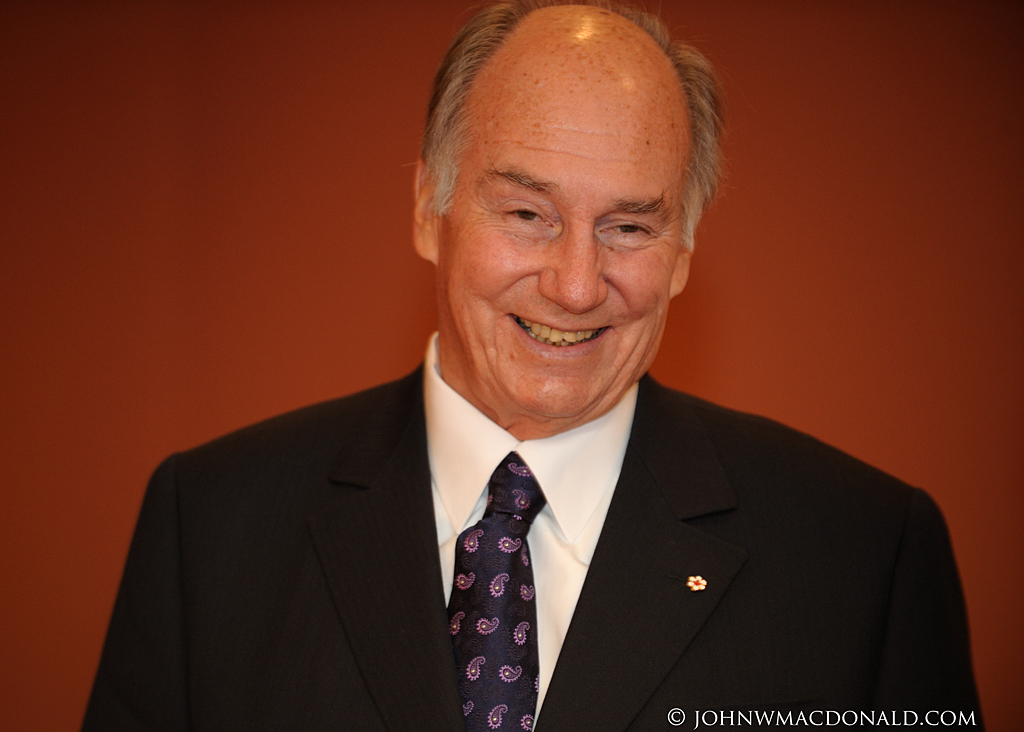
Peter Mansbridge: You must love Canada – you keep coming back here.
Aga Khan: I do.
PM: What is the quality that you most admire about this country?
AK: I think a number of qualities. First of all, it’s a pluralist society that has invested in building pluralism, where communities from all different backgrounds and faiths are happy. It’s a modern country that deals with modern issues, not running away from the tough ones. And a global commitment to values, to Canadian values, which I think are very important.
PM: Let’s talk about that a little bit, because I wonder whether your confidence in Canada has in any way been shattered a little bit in these past few years, especially since 9/11. There have been tensions in this country, as there have been in many other Western countries, between Muslim and non-Muslim societies – on any number of levels, on both sides, about history, religion, tradition and integration within society. How much has that concerned
you?
AK: It concerns me and at the same time it doesn’t, in the sense that, to me, building and sustaining a pluralist society is always going to be a work in progress. It doesn’t have a finite end. And so long as there is national intent, civic intent to make pluralism work, then one accepts that it’s a work in progress.
PM: Let me go a little deeper on that, because it raises a question you have often raised, and that’s the issue of ignorance. You reject the theory of a clash of civilizations, or even a clash of religions. You believe there’s a clash of ignorance here, on both sides of that divide. And you’ve felt that way for a long time. I was looking through the transcripts of an interview you gave in the 1980s in Canada where you were warning the West that it had to do a better job in trying to understand Islam. That clearly hasn’t happened.
AK: No, it hasn’t happened. A number of friends and people in important places have tried to contribute to solving that problem, but it’s a long-established problem. It’s going to take, I think, several decades before we reach a situation where the definition of an educated person includes basic understanding of the Islamic world. That hasn’t been the case. And the absence of that basic education has caused all sorts of misunderstandings.
PM: What’s been the resistance?
AK: I think it’s essentially historic. I think that Judeo-Christian societies have developed their own education, and basic knowledge of the Islamic world has simply been absent. Look at what was required for an education in the humanities; for example, I was a student in the U.S. and education on the Islamic world was absent.
PM: Is this a one-sided clash of ignorance?
AK: No, I think there is ignorance on both sides, and I think very often there’s confusion. I think more and more there has been confusion between, for example, religion and civilization. And that’s introducing instability in the discussion, frankly. I would prefer to talk about ignorance of the civilizations of the Islamic world rather than ignorance just on the faith of Islam.
PM: What we’ve witnessed in the last couple of years, not just in this country but in other Western countries as well, is what we call “homegrown terror,” where you see young Muslim men – born in the West, educated in the West – moving towards a fundamentalist view, a militant view of Islam. Why is that happening?
AK: There is without any doubt a growing sense amongst Muslim communities around the world that there are forces at play that it doesn’t control, that views the Muslim world with, let’s say, unhappiness or more. I would simply say, however, that if you analyze the situation I don’t think you can conclude that all Muslims from all backgrounds are part of that phenomenon. Secondly, if you go back and look at the communities where this is common, you will find that there’s a long-standing unresolved political crisis in the community. It’s very, very risky, I think, to interpret these situations as being specific to the faith of Islam. It is specific to peoples, sometimes ethnic groups, but it’s not specific to the face of Islam.
PM: That must really concern you. Your followers see you as a direct descendant of the Prophet Muhammad, the same prophet that some of these minority fundamentalist militant groups hold up and claim as the reason they’re doing the acts they’re doing.
AK: Again, I think one has to go back and say, “What is the cause of this situation?” With all due respect, if you look at the crisis in the Middle East, that crisis was born at the end of the First World War. The crisis in Kashmir was born through the liberation of the Indian continent. These are political issues originally; they’re not religious issues. You can’t attribute the faith of Islam to them. I think the second point I would make is this tendency to generalize Islam. There are many different interpretations of Islam. As a Muslim, if I said to you that I didn’t recognize the difference between a Greek Orthodox or a Russian Orthodox or a Protestant or a Catholic, I think you’d say to me, “But you don’t understand the Christian world.” Let me reverse that question.
PM: Canada’s role in Afghanistan is well-known, has been since 9/11. So is the Aga Khan Foundation, which is in there in a big way in development matters. The question is simple, really: with all the help that’s been given to Afghanistan, why is the Taliban resurging? Not only in numbers, but in popularity as well. Why is that happening?
AK: I think there are a number of reasons, but the one that I would put forward as the most immediate is the slow process of reconstruction.There was a lot of hope that once there was a regime change and a new government and the political process had been completed, the quality of life would change. It hasn’t changed quickly enough. It’s taken much more time than I think many of us had hoped to get to isolated communities in Afghanistan and improve their quality of life. It’s an organizational problem. Even amongst the donor countries there have been differences of opinion. The management of the drug problem has not been a united effort by any means. So there are a number of things that have slowed up the process. And there are still acute pockets of poverty in Afghanistan: people who don’t have enough food, people who don’t have access to any education, any health care. It is clear this sort of frustration causes bitterness and the search for other solutions.
PM: Is there time to turn it around? Because you get a sense that the pendulum has swung back considerably in the last year or so. There’s this growing sense of frustration among the Canadian people and a belief that it’s a war that cannot be won.
AK: I would beg to differ on that. I think what we’re seeing in Afghanistan, at least from my own network of activities, is an increasingly visible two-speed process, where in the north and the west you’re beginning to see quantifiable change. In the east and the south you’re not seeing that. Two-speed change is going to have to be managed with great care, but it’s not a good reason to give up by any means.
PM: Can you do both at the same time? That’s the debate in Canada: to run a military operation – talking specifically about the south – while trying to introduce aid and development in an area that is not secure.
AK: It’s very difficult to do, but necessary. Every step counts. Certainly in areas where there’s insecurity, I think the availability for populations to participate in these development activities does go down when quality of life changes. And I believe the same thing with regard to the drug problem.
PM: How much of the problem in Afghanistan is a result of the decision on the part of the Americans and the British to move into Iraq?
AK: Very substantial indeed. The invasion of Iraq was something which has mobilized what we call the Imamat – the community of Muslims around the world. Every Muslim that I have ever talked to has felt engaged by this.
PM: On what level?
AK: Baghdad is one of the great historic cities of the Islamic world. Iraq is not a new country; it’s part of the history of our civilization. It’s been a pluralist country and has produced great philosophers, great historians, great scientists. Reverse the question again. What would the Christian world think if a Muslim army attacked Rome? I think there would be a general reaction in the Christian world, not just an Italian reaction.
PM: But it seems that even in the Muslim world, that invasion has caused major divisions – the clash inside Islam itself, between Shia and Sunni.
AK: That was entirely predictable. Entirely predictable. What you are effectively doing is replacing a Sunni minority government in a country that has a Shia demographic majority. And again, what would happen – I’m sorry to come back to this, but it’s important – if a Muslim army went in to Northern Ireland and replaced one Christian interpretation by another? Imagine the fallout that that would cause in the Christian world itself.
 
PM: So what happens now? Can Iraq be put back together? And who would be doing the putting back together?
 
AK: I think that’s a very, very difficult question, and I would not want to predict the answer. Because I think that the whole process of change in Iraq has regional dimensions which have got to be managed. They’re not national dimensions in Iraq. Those regional dimensions also were predictable, let’s be quite frank about it. I think they’re going to need to be managed with very, very great care.
 
PM: Is the answer, as some suggest, the splitting of it into three regions with the main two combatants, the Shia and the Sunnis, actually separated by borders?
AK: That’s really, I think, an issue where the leaders of the three communities have got to agree or not. In my life, in the past fifty years, I have been uncomfortable with the creation of unviable states. So I would ask this question: if you did do that, what components of Iraq would be stable, viable states in the future?
PM: Who’s showing leadership in this world right now in terms of the major global issues? Who do you look to as a leader, whether it’s a political leader or not?
AK: I think there are a number of people in the U.N. system who’ve shown leadership, who have shown balanced judgment on these issues. Because when all is said and done, it’s the balance of the judgment that counts. And it’s understanding the issues. I think, amongst others, Kofi Annan has been remarkable in his understanding of the issues. He’s also had a team of people around him who are very good.
PM: It’s quite a condemnation though of the political leaders of our generation that you don’t point to one of them, no matter which side of the divide we talked about earlier. You don’t see one there?
AK: I’m looking at the regions of Africa, Central Asia, and I’m asking myself within this context who’s having the greatest influence. I think that certainly the U.N. Development Program…I think the World Bank and Jim Wolfensohn changed direction very significantly and dealt with real human issues and has done a wonderful job.
PM: Some people suggest that there’s been a movement in terms of real leadership away from governments to private foundations, philanthropic organizations – yours being one, the Gates Foundation, and you can name a number of them. Do you see that happening? Is that a good thing?
AK: I see it happening, and I welcome it wholeheartedly. Because what we’re talking about, I think, is accelerating the construction of a civil society. I personally think that civil society is one of the most urgent things to build around the world. Because one of the phenomena you see today is the number of countries where governments have been unstable. Progress is made where there’s been a strong civil society, and that’s a lesson that I think all of us have to learn. My own network is immensely committed to that. And so what the Gateses and others are doing is providing new resources, new thoughts to create civil society. Whether it’s in health care or education, it’s the combined input which is so exciting and so important.
PM: We touched briefly earlier on the new Global Centre for Pluralism, which will be established here in Canada through the Aga Khan Foundation and the people of Canada through the Government of Canada. What is your hope for that? What do you see that doing, accomplishing?
AK: I hope that the centre will learn from the Canadian history of pluralism, the bumpy road that all societies have in dealing with pluralist problems, the outcomes, and offer the world new thoughts, new ways of dealing with issues, anticipating the problems that can occur. Because in recent years I think we’re seeing more and more that no matter what the nature of the conflict, ultimately there is a rejection of pluralism as one of the components. Whether it’s tribalism, whether it’s conflict amongst ethnic groups, whether it’s conflict amongst religions, the failure to see value in pluralism is a terrible liability.
PM: Why Canada?
AK: Because I think Canada is a country that has invested in making this potential liability become an asset. I think that Canada has been perhaps too humble in its own appreciation of this global asset. It’s a global asset. Few countries, if any, have been as successful as Canada has, bumpy though the road is. As I said earlier, it’s always going to be an unfinished task.
PM: Next year is your golden jubilee: fifty years. What’s your – I was going to say what’s your dream for the world in that year, but I guess dreams are dreams. What’s your realistic hope?
AK: In areas of the world which are living in horrible poverty, I’d like to see that replaced by an environment where people can live in more hope than they’ve had. I’d like to see governments that produce enabling environments where society can function and grow rather than live in the dogmatisms that we’ve all lived through, and which I think have been very constraining. And I’d like to see solid institutional building, because, when all is said and done, societies need institutional capacity.
PM: Those are grand hopes. I’m sure they’re shared by many. How realistic do you think it is that we can achieve anything like that?
AK: I think we can achieve a lot of that. I think the time frame is what we don’t control. I remember in the mid-fifties reading about countries in the developing world being referred to as basket cases. Fifty years later those are some of the most powerful countries in the world -  enormous populations. They’re exporting food when fifty years ago we were told they’d never be able to feed themselves. They had an incredible technology deficit fifty years ago. Today they’re exporting technology, homegrown technology. So I think there are a number of cases out there where we can say what we don’t control is the time factor. But society does have the capability to make those changes.
PM: So there is reason for hope.
AK: I believe so, God willing.
Postscript by Peter Mansbridge: As inspiring as his message was, the lasting memory I take from that day was more personal. It was the beaming face of Sherali Najak standing next to the Aga Khan for that special photograph he had so wanted to get. The man who regularly bosses Don Cherry around looked pretty tame all of a sudden.
Interview Material © Canadian Broadcasting Corporation. Reprinted by Simerg permission of Random House Canada.

Saturday, July 10, 2010

Happy Imamat day to HH Aga Khan

http://worldmuslimcongress.blogspot.com/2010/07/happy-imamat-day-to-hh-aga-khan.html


The Aga Khan strongly believes and practices in serving the humanity, as it is a strong component of Islamic tradition called Huqooqul Ibad, the rights of fellow beings. Prophet Muhammad (pbuh) had said the best among you is the one who sees to it that his neighbor is fed and cared for. Imam Hazrat Ali (ra), the 4th rightly guided Caliph (Leader) who succeeded Prophet Muhammad in providing the leadership to the Muslim community says, "The best man is he who is most serviceable to fellow humans."

Dallas, Texas. Sunday, July 11, 2010.

53 Years ago today, His Highness Prince Karim Aga Khan was appointed to become the 49th hereditary Imam of the Shia Imami Ismaili Muslims succeeding his grandfather, Sir Sultan Mohamed Shah Aga Khan III.

Since then, every year on that day and the week around it, the Shia Imami Ismaili Muslims celebrate the day called the “Imamat Day” and the week of “Khushali” peace and prosperity. The Imam, in their spiritual tradition of 1400 years is called Hazar Imam, the current Imam.

Per the tradition he interprets the Quraan for daily living to his 15 million plus followers spread out across the world. He has fulfilled his role as the spiritual leader in guiding the community to prosperity and living a responsible life in the societies they live.

In gratitude for his continued guidance, the Ismaili Muslims celebrate this week honoring him and reaffirming his leadership with a renewed commitment to serving the humanity.

The Aga Khan strongly believes and practices in serving the humanity, as it is a strong component of Islamic tradition called Huqooqul Ibad, the rights of fellow beings. Prophet Muhammad (pbuh) had said the best among you is the one sees to it that his neighbor is fed and cared for. Hazrat Ali, the 4th rightly guided Caliph (Leader) who succeeded Prophet Muhammad in providing the leadership to the Muslim community says, "The best man is he who is most serviceable to fellow humans."

One of the sayings of Hazrat Ali that resonates with me on a daily basis is, “A wise man needs each day an hour to set apart in which to examine his conscience, and measure what he as gained or lost”. My Maternal Grand father Shaikh Hussain said “if you attend a funeral of a stranger to match each wedding you attend of a friend, the contrast will straighten you out to become a humble servant of humanity known as Khaksar.”

Both Prophet Muhammad (pbuh), Imam Hazrat Ali (ra) had continuously advocated living in a moderation and a mid path between the worldly and spiritual needs. The Aga Khan has fine tuned that balance between living for oneself materially and living for the others spiritually and has founded the Aga Khan Development Network that is committed to serving the humanity without regard to faith, origin or gender. I believe AKDN (http://www.akdn.org/) is one of the largest Non Governmental bodies serving humanity to stand on their own feet.

We wish a very happy Imamat day and Khushali to the Shia Imami Ismaili Muslims and blessing of long life to the Hazar Imam HH Karim Aga Khan. Amen!

Link: http://worldmuslimcongress.blogspot.com/2010/07/happy-imamat-day-to-hh-aga-khan.html

PN: I have been sharing the essence of celebrations and commemorations of every religious and cultural traditions under the title "Festivals of the world" for over 15 years now under the banner of Foundation for Pluralism. I don't write/speak on every one of the events, but surely make an attempt to do as many as I can in the time I have avaialable to me in a given day. The idea is for us to know a little bit about each other, as it paves the way to greater understanding and a cohesive life.

Mike Ghouse is a speaker, thinker, writer, optimist, educator and an activist of Pluralism, Justice, Islam, India, Peace and Civil Societies. He is a conflict mitigater and a goodwill nurturer offering pluralistic solutions on issues of the day and is a frequent guest on the media. Mike's work is reflected at three websites & twenty two Blogs listed at http://www.mikeghouse.net/

Saturday, April 25, 2009

Speech by His Highness the Aga Khan

A note by Mike Ghouse: With an open heart and an open mind as you believe in "Balance", you will find that His Highness Aga Khan focusess on consciously creating societies of balance; spiritual, religious, civic, economic and social balance in every speech he makes, you can hear that theme. Many of his speeches are published at the Foundation for Pluralism and world Muslim Congress websites and blogs. He is one of my mentors and I look forward to reading or listening to his words of wisdom.
.
.
Speech by his Highness Aga Khan at the Global Philanthropy Forum -23 April 2009
President Jane Wales, thank you for those very generous comments. I'd like to say how happy I am to share in this year's Global Philanthropy Forum.

Participants, Excellencies, Ladies and Gentlemen,
It is a special pleasure for me to be with you tonight, for I look upon you as particularly serious and informed partners in the work of global understanding and international development.
As you may know, I recently marked my 50th anniversary in my role as Imam of the Shia Imami Ismaili Muslims. This responsibility connects me intimately with the traditions of the Islamic faith and cultures, even while my education and a host of personal and professional associations have acquainted me with the non-Islamic West. The relationship of these two worlds is a subject of considerable importance for me - a relationship which some define, regrettably, as an inevitable Clash of Civilizations. My own observation, however - and my deep conviction - is that we can more accurately describe it as a Clash of Ignorances
.
It is not my purpose tonight to detail the misunderstandings which have plagued this relationship. Let me only submit that educational systems on both sides have failed mightily in this regard - and so have some religious institutions. That - at this time in human history - the Judeo Christian and Muslim societies should know so little about one another never ceases to astonish - to stun - and to pain me.

As a Muslim leader speaking in Washington this evening, it seems appropriate that I cite the words of President Obama, in his recent speech in Ankara. As he put it, pledging a "broader engagement with the Muslim world, we will listen carefully, we will bridge misunderstandings, and we will seek common ground." I know that the vast majority of the Islamic world shares these objectives.
.
Among the areas where we can find common ground is our mutual effort to address the problem of persistent global poverty, especially the endemic poverty of the developing world. Surely this is an area where we can listen and learn and grow together - establishing ever-stronger bonds of understanding. One of the great principles of Islam, in all its interpretations, is the elimination of poverty in society, and philanthropy's centrality in this duty.
.
When I succeeded my grandfather as Aga Khan in 1957, I was a student at Harvard - but speaking mostly French. I got extra English practice, however, from my new official routine of regular communication with Africa and Asia - and, in the bargain, was kept in great good humour by the amazing typographic errors which inevitably arose. But then computerized spell check programs came along - and all those charming idiosyncrasies disappeared!

I recently noticed, to my joy, however, that this new invention is not a fail safe protection. Consider this recent item in the publication "The Week: "Bad week for spell-check: Several Pennsylvania high school students had their last names changed in their yearbook by an automatic computer program, Alessandra Ippolito was listed as Alexandria Impolite, while Max Zupanovic was rechristened Max Supernova. And Kathy Carbaugh's photo appeared next to the name Kathy Airbag."

After reading this, I decided that maybe I should act prudently and spell check my own name. And I found that, while there was no "Aga Khan", there was an "Aga" Cooker. It was defined as one of England's oldest stoves and ovens - now somewhat outdated - but with a distinctive whistle every time it frizzled the food within!

But returning to a more serious topic let me submit this evening a few of my own reflections on the developing world that I know a central focus of my interests over fifty years. For, in coming to understand the life of widely dispersed Ismaili communities across the globe, I have also become immersed in their host societies.

The essential goal of global development has been to create and sustain effective nation states - coherent societies that are well governed, economically self-sustaining, equitable in treating their peoples, peaceful amongst themselves, and sensitive to their impact on planetary sustainability.
This is a complex objective, a moving target, and a humbling challenge. Sadly, the response in the places I know best has often been "one step forward and two steps back."

Today, some forty percent of UN member nations are categorized as "failed democracies" - unable to meet popular aspirations for a better quality of life. The recent global economic crisis - along with the world food crisis - has sharply accentuated these problems.

But why have our efforts to change that picture over five decades not borne greater fruit? Measured against history, where have things gone wrong? Given the progress we have made in so many fields, why have we been so relatively ineffective in sharing that progress more equitably, and in making it more permanent?

My response centers on one principal observation: I believe the industrialized world has often expected developing societies to behave as if they were similar to the established nation states of the West, forgetting the centuries, and the processes which molded the Western democracies.

Forgotten, for one thing, is the fact that economic development in Western nations was accompanied by massive urbanization. Yet today, in the countries of Asia and Africa where we work, over 70 percent of the population is rural. If you compare the two situations, they are one and a half to two and half centuries apart. Similarly, the profound diversity of these impoverished societies, infinitely greater than that among nascent European nation states, is too often unrecognized, or under-estimated, or misunderstood. Ethnic, religious, social, regional, economic, linguistic and political diversities are like a kaleidoscope that history shakes every day.
.
One symptom of this problem has been the high failure rate of constitutional structures in many developing countries, often because minority groups - who often make up the bulk of the population - fear they will be marginalized by any centralized authority. But did today's developed countries not face similar challenges as they progressed toward nationhood?

If there is an historic misperception here, it has had several consequences for development activities.

The first concerns what I would call the dominant player fallacy - a tendency to place too much reliance in national governments and other institutions which may have relatively superficial connections to life at the grass-roots level.

Urban-based outsiders often look at these situations from the perspective of the city center looking out to a distant countryside, searching for quick and convenient levers of influence. Those who look from the bottom-up, however, see a much much more complex picture. The lines of force in these rural societies are often profoundly centrifugal, reflecting a highly fragmented array of influences. But was this not also true during the building of Western nation states?

Age old systems of religious, tribal or inherited family authority still have enormous influence in these societies. Local identities which often cross the artificial frontiers of the colonial past are more powerful than outsiders may assume. These values and traditions must be understood, embraced, and related to modern life, so that development can build on them. We have found that these age-old forces are among the best levers we have for improving the quality of life of rural peoples, even in cross frontier situations.

Nation building may require centralized authority, but if that authority is not trusted by rural communities, then instability is inevitable. The building of successful nation states in many of the countries in which I work will depend - as it did in the West - on providing significantly greater access for rural populations, who are generally in the majority.

If these reflections are well founded, then what is urgently needed is a massive, creative new development effort towards rural populations. Informed strategic thinking at the national level must be matched by a profound, engagement at the local level. Global philanthropy, public private partnerships and the best of human knowledge must be harnessed.

As the World Bank recognized in its recent Poverty Study, local concerns must be targeted, providing roads and markets, sharpening the capacities of village governments, working to smooth social inequalities, and improving access to health and education services. The very definition of poverty is the absence of such quality of life indicators in civil society among rural populations.

It is in this context that I must share with you tonight my concern that too much of the developmental effort - especially in the fields of health and education - have been focused on urban environments.

I whole-heartedly support, for example, the goal of free and universal access to primary education. But I would just as whole-heartedly challenge this objective if it comes at the expense of secondary and higher education. How can credible leadership be nurtured in rural environments when rural children have nowhere to go after primary school? The experience of the Aga Khan Development Network is that secondary education for rural youth is a condition sine qua non for sustainable progress.

Similarly despite various advances in preventive medicine, rural peoples - often 70% of the population - are badly served in the area of curative care. Comparisons show sharp rural disadvantages in fields such as trauma care and emergency medicine, curbing infant mortality, or diagnosing correctly the need for tertiary care. Building an effective nation state, today as in earlier centuries, requires that the quality of rural life must be a daily concern of government. Ideally, national progress should be as effective, as equitable, and as visible, over similar time-frames, in rural areas as in urban ones. Amongst other considerations, how else will we be able to slow, if not stop, the increasing trend of major cities of Asia and Africa to become ungovernable human slums?

From this general analysis, let me turn to our own experience. The Aga Khan Development Network, if only as a matter of scale, is incapable of massively redressing the rural-urban imbalances where we work. It is possible, however, to focus on areas of extreme isolation, extreme poverty and extreme potential risk - where human despair feeds the temptation to join criminal gangs or local militia or the drug economy. The World Bank refers to these areas as "lagging regions". We have focused recently on three prototypical situations.
Badakhshan is a sensitive region of eastern Tajikistan and eastern Afghanistan where the same ethnic community is divided by a river which has now become a national border, and where both communities live in extreme poverty and are highly isolated from their respective capitals of Dushanbe and Kabul. There is a significant Shia Ismaili Muslim presence in both areas.
Southern Tanzania and Northern Mozambique is a region of eastern Africa where large numbers of rural Sunni Muslims live in extreme poverty.

A third case, Rural Bihar, in India, involves six states where the Sachar Committee Report, commissioned by the Indian government, has courageously described how Muslim peoples have been distanced from the development story since 1947.

All three of these regions are works in progress. The first two are post conflict situations, relatively homogeneous, and sparsely populated, while the third is densely populated, and culturally diverse. All three have acute potential to become explosive, and our AKDN goal is to identify such areas as primary targets for philanthropy.

We have also developed a guiding concept in approaching these situations. We call it Multi-Input Area Development - or MIAD. An emphasis on multiple inputs is a crucial consequence of looking at the development arena from the bottom up. Singular inputs alone cannot generate, in the time available, and across the spectrum of needs, sufficient effective change to reverse trends towards famine or towards conflict.

Similarly, we want to measure outcomes in such cases by a more complex array of criteria. What we call our Quality of Life Assessments go beyond simple economic measurements - considering the broad array of conditions - quantitative and qualitative - which the poor themselves take into account when they assess their own well-being.

Secretary Clinton echoed the concern for multiple inputs and multiple assessments when she mentioned to you yesterday the need for diversified partnerships among governments, philanthropies, businesses, NGO's, universities , unions, faith communities and individuals. The Aga Khan network includes partners from most of these categories - sustaining our Multi-Input strategy. I applaud her concern - and yours - for the importance of such alliances.

Northern Pakistan provides another example, in a challenging high mountain environment, of a complex approach to rural stabilization. Innovations in water and land management have been accompanied by a new focus on local choice through village organizations. A "productive public infrastructure" has emerged, including roads, irrigation channels, and small bridges, as well as improved health and education services. Historic palaces and forts along the old Silk Route have been restored and reused as tourism sites, reviving cultural pluralism and pride, diversifying the economy and enlarging the labor market. The provision of micro credit and the development of village savings funds have also played a key role.

For nearly 25 years, we have also worked in a large, once-degraded neighborhood, sprawling among and atop the ruins of old Islamic Cairo - built 1000 years ago by my ancestors, the Fatimid Caliphs. This is an urban location - but occupied by an essentially rural population, striving to become urbanized. The project was environmental and archaeological at the start - but it grew into a residential, recreational and cultural citiscape - which last year attracted 1.8 million visitors. The local population has new access to microcredit and has been trained and employed not only for restoring the complex, but also for maintaining it - as a new expression of civil society.
.
Because historic sites are often located among concentrations of destitute peoples, they can become a linchpin for development. We work now with such sites as Bagh-e-Babur in Kabul, the old Stone Town in Zanzibar, the Aleppo Citadel in Syria, the historic Moghal sites at New Delhi and Lahore, and the old mud mosques of Mopti and Djenne and Timbuktu, in northern Mali. Altogether, more than one million impoverished people will be touched by these projects. Such investments in restoring the world's cultural patrimony do not compete with investing in its social and economic development. Indeed, they go hand in hand.

In all these cases, it is the interaction of many elements that creates a dynamic momentum, bringing together people from different classes, cultures, and disciplines, and welcoming partners who live across the street - and partners who live across the planet. Each case is singular, and each requires multiple inputs. And it is here that those present tonight can have such an important impact. Working together on programme development, on sharing specialized knowledge, and on competent implementation, we can all contribute more effectively to the reduction of global poverty.

Let me say in closing, how much I admire the work you are doing, the commitment you feel, and the dreams you have embraced. I hope and trust that we will have many opportunities to renew and extend our sense of partnership as we work toward building strong and healthy nation states around our globe.

If we are to succeed we will need, first, to readjust our orientation by focusing on the immense size and diversity of rural populations whether they are in peri-urban or rural environments. For no-one can dispute, I think, that a large number of the world's recent problems have been born in the countrysides of the poorest continents.

Finally, we will need to address these problems with a much stronger sense of urgency. What we may have been content to achieve in 25 years, we must now aim to do in 10 years.
A mighty challenge, no doubt.

Thank you.
# # #
MIKE GHOUSE NOTES:
.
I would like to dedicate the essence of this speech to Mary Ann Thompson-Frenk, co-founder of Memnosyne Foundation who is consciously creating a world of co-existence by providing mankind with the means to encourage positive, peaceful global collaboration in all areas of knowledge, and Dr. Abusaleh Shariff, my friend who did the pioneering research work in understanding the minority demographic component of a nation. This report has been quoted by the United Nations and virtually every leader in the world, it is first of its kind. This report can be extrapolated to every nation and every tribe where there is a lack of demographic balance in the overall society. Shariff wrote the Sacchar report for Prime Minister Singh mentioned by his Highness. Further notes at the bottom of the article.
Life and matter is about balance; every thing that came out of the big bang theory or through intentional creation seeks its own balance. Everything be it matter or life, has a built-in mechanism to seeks its own balance.When it comes to matter, there is something that keeps the planets circumambulating around the Sun, that there is something that keeps the stars hung in a place. There is something that keeps the earth have its own precise balance. They are all put on a trajectory, they don’t have to think or work for the balance. Do we have a precise word to describe that 'something', for the sake of convenience and for a greater acceptance, can we call that 'something' a God? (Abstract from my speech)

Unlike the matter, human life was not put on a trajectory; we were not put on a plan to circumambulate around something, or hung in one place. We were given the freedom to create our own balance. Whether we believe in God or not, we still seek that balance. Friends, God loves his creation just as each one of us loves what we create, be it the food we cook, the clothes we wear, the paintings we paint or sculptures we sculpt.
.
You have to take time to understand and honor the greatness in each human; My personal list of mentors who have consistently inspired me for their inclusive attitudes are; Muhammad, Jesus Christ, Rama, Mahatma Gandhi, Mother Teresa, Martin Luther King and Aga Khan and my Dad and Mom. I am watching Barack Obama, he is on and off and hope in a few years, he will drop the "war" as a solution to humanity's issues, then he will become my mentor as well.
.

Sunday, June 1, 2008

Aga Khan - Democracy & Pluralism

Where Hope Takes Root: Democracy and Pluralism in an Independent World (Hardcover)
by Aga Khan (Author)

BOOK REVIEW

2008, May: Douglas & McIntyre - Where Hope Takes Root:
Democracy and Pluralism in an Interdependent World -
By: His Highness The Aga Khan.

Where Hope Takes Root, a collection of talks given over the past sixyears, the Aga Khan sets out the principles that inform his vision of peaceful, productive societies.
He returns again and again to the three cornerstones upon which his many years of work in the developing world are based: democracy, pluralism and civil society.

Democracy, always fragile, must be nurtured in practical and flexible ways, he says. Pluralism must be embraced in both fact and spirit. And engaged civil society, which the Aga Khan defines broadly as including doctors’ and journalists’ associations, women’s groups, social movements and village organizations, must be actively supported in countries around the globe

For more details,http://www.douglas-mcintyre.com/book/9781553653660

Book details:
May 2008 ISBN 978-1-55365-366-0 Hardcover 5" x 7" 144 pages Political Science $24.95 CAD

Monday, April 21, 2008

Architect of universal good

http://worldmuslimcongress.blogspot.com/2008/04/architect-of-universal-good.html

The architect of universal good
By Ashfaq Ahmed, Staff Writer
Published: April 18, 2008, 00:28

The global Muslim “Umma” needs to develop a form of democracy that fits its social, ethnic, religious and economic structure, said Prince Karim Aga Khan, Imam of the Ismaili Muslim community.

“We have to look at the nature of democracy because I don’t believe that one shape fits all. I believe the Umma, like many other parts of the world, needs to develop its own form of democracy to overcome the issues Muslims are facing,” he said.

The Aga Khan noted that the Muslim Umma today is highly pluralistic and that it is going to function as a body of brotherly states.

“Acceptance of pluralism and investing in pluralism is to be one of the principles we have to look at to resolve issues facing the Muslims,” he said.

In an exclusive interview with Weekend Review during his visit to Dubai, where he inaugurated the Ismaili Centre, the Aga Khan said the problems of extremism and terrorism have nothing to do with Islam.

“I personally don’t ascribe these to Islam. I ascribe these to a portfolio of political issues — be it issues in the Middle East, Afghanistan or Kashmir,” he said.

The soft-spoken Aga Khan, who has a charismatic personality, has nearly 15 million followers around the world. Today, Ismailis live in some 25 countries — mainly in west and central Asia, Africa, the Middle East and in North America and Western Europe. The United Arab Emirates hosts some 5,000 Ismailis.

During the interview, the Aga Khan talked about the spirit behind Ismaili Centres, his development work in the fields of education, healthcare, architecture, culture, microfinancing and his vision to alleviate poverty.

He thanked His Highness Shaikh Mohammad Bin Rashid Al Maktoum, Vice-President and Prime Minister of the UAE and Ruler of Dubai, for making the site available for construction of the Ismaili Centre in Dubai.

Excerpts:

What are the issues facing the Muslim Umma?

First, the globalisation of the knowledge of the cultures of the Umma is critical. We have to make known the cultural inheritance of the Muslims to the non-Muslim as well as the Muslim parts of the world because we will never succeed in building the respect and recognition that the Umma deserves unless we present the Umma as a remarkable carrier of civilisation.

The misconceptions about Islam and Muslims in the West exist because we are, even today, absent from the global civilisation. We should encourage the Western education system to bring in knowledge of the civilisation of Islam into the secondary education system.

I am thrilled with the initiative that Dubai and other states in the Gulf are taking by creating museums. Retracing our historical legacies and bringing them back in the modern world is extremely important.

How do you see the problem of terrorism in the world? Do you think it is widening the gap between the West and the Muslim world or even the Muslims and the non-Muslims?

I personally don’t ascribe these [extremism or terrorism] to Islam. I ascribe these to a portfolio of political issues. I consider these political issues the essence of the problem in the Middle East. It started in 1917 and, since then, the problem has been becoming worse.

The problem of Kashmir is again a political problem which started after withdrawal of the British from the subcontinent. Similarly, the problem in Iraq today is also political and has nothing to do with Islam.

But now we have an overlay. Since these political problems are located in the parts of the Muslim Umma, the totality of the Umma is being held responsible for this situation.

The media also tends to concentrate on the problem areas even as they ignore the Umma’s successes. Painting a negative picture of the entire situation is wrong because it does not involve the face of Islam. It involves essentials of politics within the Islamic world.

Secondly, it [the problem of extremism and terrorism] does not cover the Islamic world alone. Countries in Eastern Europe, Ireland and Spain face similar issues. I think that we should not say that the Umma is unstable and the rest of the world is perfect.

What should be done to resolve this issue?

More efforts are needed to resolve political crises. I think there are governments and organisations that recognise that the longer these problems continue, the more difficult they will be to solve. Similarly, the Irish problem and the Spanish problem have also been there for decades.

There have been theories about what brought unrest in the world. Do you think the world is heading towards a “clash of capturing natural resources”?

I think you are right. People are looking for a better quality of life and they are in a hurry. There is, in many countries, a sense of time lost. And when there is a sense of time lost, there is also a sense of urgency.

In the developing world, the sense of urgency is getting stronger. I think it is leading a number of forces to look at resources they can mobilise to harness those resources to the development process.

I think we are seeing a concentration of wealth in a number of countries. There is a search for new resources to exploit for national or strategic purposes. The situation can be changed by making a move towards using nuclear power, as it has the potential to change the global economic scenario.

Congratulations on the golden jubilee of your Imamat. Are you launching any special projects to mark this special year?

I am hoping to develop two new projects by the end of this year. The first is the sociological analysis of the communities around the world and an attempt to redefine the nature of acute poverty. We think that certain segments of the population in many countries are ultra poor.

As we see economies evolve, we are worried these segments will continue to become more and more poor. We are trying to understand the causes of this phenomenon in order to reduce, if not eliminate, poverty.

We believe poverty is not only economic but social as well. Families have no access to the platform from which they can grow, no access to healthcare, education, micro-credit or even a normal support system. It is a problem and should be addressed.

As far as our second programme is concerned, we are going to concentrate on increased longevity. People are living longer and the aged are increasingly finding themselves isolated from their families and from society. We would like to develop a programme to create a capacity to care for these people.

Since extended families are becoming less common in the industrialised world, it is now important to look at this issue. Through this programme, we will try to help the aged live an honourable life.

Also, during this jubilee year, we will lay the foundation of a number of educational and health institutions.

The Aga Khan Development Network has numerous projects focusing on communities. How do you select the areas and why?

We select areas to launch projects on a case-by-case basis. The projects stem from the analysis of the absence of certain facilities. If we find there is no credit system in isolated areas, we go for microcredit programmes. If we find a government wants to privatise an industry which has gone wrong, we try to step in. So it is with our educational, healthcare and cultural development projects around the world.

What is your vision of development?

There is a realisation that development should be in human terms. And to be measured in human terms, you have to look at quality of life, which is directly linked to education, housing and healthcare.

Today, many of the world’s economic and financial institutions have moved away from lending only for economy activities. They are lending for educational and health initiatives. This is changing the nature of the development support system.

The private sector in the fields of education, healthcare and microcredit can also be very important. It is in the interest of the developing countries to have a composite of facilities [which can be achieved] by involving both the private and public sectors.

What do you think you have achieved through your massive network of community development projects?

Success depends on the maturity of the projects. We have considerable maturity in our healthcare and educational projects and they have been serving the purpose. But we have less maturity in our cultural initiatives.

We are beginning to see the trend in cultural initiatives and I would love to say I have the confidence in the cultural initiatives but they are still young.

One of the important cultural projects — aimed at improving the quality of life —was the development of Al Azhar Park in Cairo. I am confident that we can replicate the cultural project in other parts of the world.

By launching such cultural projects, our focus is to improve quality of life and create opportunities for the ultra poor. Why did you set up an Ismaili Centre in Dubai and what is your vision behind setting up such centres in other countries? I think the creation of the Ismaili Centres is important because they represent the Ismaili community in the important countries in the world.

I hope that the centre will bring a sense of institutional purpose. We call them ambassadorial buildings because they are representatives of the Ismaili community and all its aspirations.

We first started building the centres in the West. Like the Ismaili Centres in London, Vancouver and Lisbon, the Ismaili Centre in Dubai will reflect a mood of humility, forward outlook, friendship and dialogue. More such centres are on the cards in Toronto and Dushanbe.

The buildings have a two-fold purpose. First, they serve as institutions for the Ismaili community and, secondly, they reach out to groups of people, creating spaces for quality exhibitions, culture and musical representation.

These centres allow us to build bridges for interaction among various communities, areas and cultures. You have been involved in so many things. What do you do in your leisure?

(Laughs) Usually it is work, work and more work. Occasionally, if I am able to get out, I go to the sea, to the snow or I look at the thoroughbreds that we have, because it is essentially the hobby that fits into the time that I have.

Any message for the community?

The spirit of Islam is to share knowledge and I always tell the community not to think in material terms. Think in terms of knowledge and think what you can offer our institutions in various parts of the world.

Raise our performance in healthcare, education, financial services and in civil society.

Many minorities from the Middle East countries are living in the West. Just think how wonderful it would be if young women and men return to their respective countries to strengthen institutions and do voluntary work for their countries.

Addressing social challenges

The Aga Khan Development Network (AKDN) is a group of private, non-denominational development agencies whose mandates range from the fields of healthcare and education to architecture, rural development and the promotion of private-sector enterprise.

Its agencies and institutions, working together, seek to empower communities and individuals, often in disadvantaged circumstances, to improve living conditions and opportunities, and promote creative solutions to problems that impede social development, primarily in Asia and East Africa.

They collaborate in working towards a common goal — building institutions and programmes that can continuously respond to the challenges of social, economic and cultural change.

Active in more than 20 countries in Europe, Asia, Africa and North America, the network’s underlying impulse is the ethic of compassion for the vulnerable in society. Its agencies and institutions work for the common good of all citizens, regardless of origin, gender or religion.

The network’s agencies are active in the Gulf and Middle East regions in the areas of urban development, conservation, restoration, education, healthcare, microfinance, higher education, culture and rural development.

The AKDN is an independent self-governing system of agencies, institutions, and programmes under the leadership of the Ismaili Imamat. Their main sources of support are the Ismaili community with its tradition of philanthropy, voluntary service and self-reliance.

Prince Karim Aga Khan

Prince Karim Aga Khan became Imam (spiritual leader) of the Shia Imami Ismaili Muslims on July 11, 1957, succeeding his grandfather Sir Sultan Mohammad Shah Aga Khan.

He is the 49th hereditary Imam of the Shia Imami Ismaili Muslims.

Son of Prince Aly Khan and Princess Tajuddawalah Aly Khan, the Aga Khan was born on December 13, 1936, in Geneva. He spent his early childhood in Nairobi, Kenya, and then attended Le Rosey School in Switzerland for nine years.

He graduated from Harvard University in 1959 with a BA Honours Degree in Islamic History. He emphasised the view of Islam as a thinking, spiritual faith: one that teaches compassion and tolerance, and upholds the dignity of man.

In the course of history, the Ismailis have, under the guidance of their Imams, made major contributions to the growth of Islamic civilisation. The Aga Khan has one daughter and three sons. They are Princess Zahrah, Prince Rahim, Prince Hussain and Prince Aly Mohammad.

The Ismaili community is at present celebrating the golden jubilee of the Aga Khan’s Imamat, which began on July 11, 2007, and will continue until July 11 this year.

The Aga Khan has plans to pay official visits to some 35 countries during this year and use this occasion to recognise the friendship and support of leaders of the state and government and other partners in the work of the Ismaili Imamat, and to set the direction for the future, including laying the foundations of major initiatives and programmes.

http://archive.gulfnews.com/articles/08/04/17/10206325.html

Please read: Aga Khan, 50 years of Imamat for potential representation of Muslims, as Pope represents Christians.

Global Religious leaders

http://worldmuslimcongress.blogspot.com/2008/04/global-religious-leaders.html

I am pleased to read this piece on HH Aga Khan by Reza Aslan. Indeed, when I wrote the article: Aga Khan, 50 years of Imamat I thought about the lack of coverage by the media to two of the worlds' greatest spirtual leaders. Mike Ghouse
#####

The OTHER global religious leader visiting America

http://ac360.blogs.cnn.com/2008/04/18/the-other-global-religious-leader-visiting-america/

Reza Aslan
Author, “No god but God”

The media spotlight on Pope Benedict’s first trip to the United States seems to have completely overshadowed the American tour of another global religious leader, the Aga Khan.

The Aga Khan is the spiritual leader of some 20 million Ismaili Muslims. The Ismailis are Shiah who broke off from the main Shiite branch of Islam, known as the Ithna Ashari, or Twelvers, in the middle of the 8th century. Ismailis live primarily in South Asia, while some 300 million Twelver Shia live mostly in Iran, Iraq, and other parts of the Middle East.

The Aga Khan — the title means something like “the Noble Lord” — is believed to be a direct descendant of the Prophet Muhammad. As such, his position among followers is absolute. He has sole authority to interpret the Quran and Islamic law, and his word on both subjects is infallible. But this Aga Khan, the 49th imam in a line that stretches back 13 centuries, is unlike any other spiritual leader.

He is a graduate of Harvard University. His personal worth is estimated to be in the billions. He jaunts around the globe in private jets and yachts. His father, the previous Aga Khan, was once married to Rita Hayworth. In his fitted suits and silk ties, he looks more like a well-aged movie star than a spiritual leader.

But don’t let the clothes and the fabulous riches fool you. The Aga Khan is not only a devout and transcendent man of deep religious faith, he is also one of the most generous philanthropists in the world.

His Aga Khan Development Network is a massive charitable fund dedicated almost entirely to caring for the poor. He runs nearly 200 hospitals. He funds thousands of schools, charities, arts programs, museums, and theaters.

His humanitarian services extend across the globe and, despite being funded almost exclusively by the tithes of his followers, are doled out to people of all faiths, whether Muslim or not.

He is a shining example of a moderate, pluralistic, and modern Muslim leader, which is why it’s a shame that he has come to the U.S. at such an inopportune time. (He is here to celebrate his 50th year as the Aga Khan).

For those of us who are sick and tired of media pundits always asking, “where are the moderate Muslim leaders,” and for those who want to punch something every time Tom Friedman sarcastically wonders why there are no “Muslim Mandela’s” out there, the Aga Khan, and the millions of modernist, democratically minded, reformist, and pluralist Muslims who follow him, are the perfect answer.

Too bad no one is paying attention.

Filed under: Aga Khan • Reza Aslan

Saturday, April 12, 2008

Aga Khan visits Atlanta

Famous Muslim philanthropist, businessman to visit Atlanta
By CHRISTOPHER QUINN
The Atlanta Journal-Constitution 04/12/08 Avoiding the paparazzi won't be a problem for the Aga Khan when he dines at the Governors Mansion Friday.

The lack of photographic gadflies in Atlanta will be a break for the man born Karim al-Hussaini, one of the world's premiere philanthropists and businessmen who gets mentioned in the social pages of European newspapers.

The Aga Khan, right, shows his delight with jockey Mick Kinane, left, after his horse Azamour won the Prince of Wales Stakes on June 15, 2005.

Though he is not as well known here as billionaires such as Bill Gates, the Aga Khan has a cachet no American will ever have.

He traces his descent from the Prophet Mohammed. Thanks to his high-living father, the 71-year-old also once called actress Rita Hayworth his stepmother.

He is a man of other seeming contradictions in Western eyes. His interpretation of the Quran, Islam's holy book, guides the 15 million Ismaili Muslims who follow him. But strict Muslims from other groups frown upon his stables of race horses on which people gamble.

He is deferred to by Ismailis as if he were a medieval prince, but he is a force for modernization and pluralism in Islam. He is fabulously rich but runs one of the world's largest private development networks focusing on the poor.

This socially conspicuous but very private man arrives in Georgia Thursday. He is visiting Ismailis around the world to celebrate his 50th anniversary as imam, a hereditary title conferred on him by his grandfather.

He will also make time to chat with people from the Centers for Disease Control and Prevention about cooperating with some of his Middle Eastern and south Asian medical facilities to keep an eye on infectious and chronic diseases.

Friday, he dines with Perdue and about 75 guests in his honor. "He has the sort of head of state equivalence when he meets with people, just as the Dalai Lama has head of state equivalence. We are talking about someone who, if you will, is kind of a prince or lord and leader of this group," said Gordon Newby, professor of Middle Eastern and South Asian Studies at Emory University.

The Ismailis are one of several minority offshoots of Shiites, one of the two major branches of Islam. Westerners know Shia Muslims as those who control the government in Iran and as the religious order of Sheik Muqtada al-Sadr, the glowering Iraqi power broker whose militias often clash with American soldiers.

But the Ismailis know what it is to clash with other Muslims, who have persecuted them in the past. Because of that, and because of their community's emphasis on education and its entrepreneurial spirit they have dispersed around the globe. Ismaili students arrived in Georgia in the 1960s and 1970s planting the seeds from which the community has grown. There are about 5,000 in Georgia.

Ismailis pay the Aga Khan a tithe of their money every year, and he in turn uses the money to support his development network. He also inherited the family fortune, which includes global business interests.

The personal worth of the man, who lives in France and has British citizenship, is a closely held information, but his works and interests are evident in Africa and south Asia, where his family roots lie.

He mixes business with philanthropy, providing jobs and infrastructure to poor parts of the world. His widely diversified business interests include dams, power plants, communications and manufacturing. They finance micro loans of less than $100 and control banks and insurance companies that hold billions in assets. There are hundreds of schools and two universities, and hundreds of health clinics, and cultural centers. He has helped preserve and restore millions of dollars worth of culturally important historic sites.

He has said in rare interviews that he is building the infrastructure that is the foundation for countries' successes.

Vartan Gregorian, the president of New York's Carnegie Corporation, has known the Aga Khan for 30 years.

"He is not only a spiritual leader, but he sets the tone as a kind of constructive bridge builder between East and West," Gregorian said by phone.

The Aga Khan encourages his followers to participate in the cultures where they find themselves. He embraces change and the best of modernism, such as science, education for women and interfaith dialogue, he said.

In Atlanta, Ismaili youth help coordinate the annual Partnership Walk, which raises money for Third World relief. It attracted about 7,000 participants last year. They volunteer at charities such as MedShare International in Decatur and Habitat for Humanity.

Newby said, "You don't hear about him a lot, but those who do know him find him to be someone who is working steadily and quietly for peace and for making the world a better place."

ISMAILI ISLAM

There are an estimated 15 million Ismailis worldwide out of more than 1 billion Muslims. They take their name and divide with other Muslims over an eighth-century disagreement over religious leadership. They are the followers of Ismail bin Jafar, whose descendants now hold the title Aga Khan, referred to by followers as His Highness.

The Aga Khan's family roots lie in Iran, but the family fled to Pakistan and India in the 1840s after political troubles.

Ismailis believe in more esoteric, layered meanings rather than literal translations of the Quran, Islam's holy book. The Aga Khan, called the imam (religious leader) of the time, is the final authority on interpretation and religious questions.

Part of Ismailis' religious duty as defined by the Aga Khan is allegiance to and participation in the country they live in, along with self-reliance, education and charity.

Ismailis meet, as do other Muslims, on Friday for religious services. Non-Ismailis may not participate because of religious requirements of ritual purity. A distinctive part of their ceremonies includes ginans, which are poetic songs and recitations of spiritual wisdom and theology.

There are differences with other branches of Islam, such as praying three times a day rather than the five times required by mainstream Muslims.

THE AGA KHAN:

• 1959 graduate of Harvard with a degree in Islamic history.

• 49th Ismaili imam (religious leader) descended from Muhammad.

• The Ismaili community once weighed his grandfather, the preceding Aga Khan, and gave him his weight in diamonds, reported to be 243 pounds.

THE AGA KHAN DEVELOPMENT NETWORK:

• Owns stakes in 90 companies worldwide.

• Employs more than 30,000 people and produces annual revenues of more than $1.5 billion.

• Oversees 325 schools and two universities.

• Operates nine hospitals and 190 clinics and community health centers in 30 countries.

• Established a $58 million endowment at Harvard and Massachusetts Institute of Technology to promote and preserve Islamic architecture.

U.S. AGA KHAN FOUNDATION

• Nonprofit working in relief, education and development.• Nonprofit working in relief, education and development.

• Collected $38,986,474 in donations and $14,645,583 in grants.

• Held $115,041,902 in total assets in 2005.

http://www.ajc.com/living/content/living/stories/2008/04/11/AgaKhan_0412.html

iiiiiiiiiiiiiiiiiiiiiiiiiiiii[(Fort Worth Star Telegram )] iiiiiiiiiiiiiiiiiiiiiiiiiiiii

http://www.star-telegram.com/448/story/575589.html

Ismaili Muslim leader to tour U.S. for community's Golden Jubilee
http://www.statesman.com/


AUSTIN -- The Aga Khan, spiritual leader of 20 million Ismaili Muslims around the world, was expected to arrive in Texas on Friday for an eight-day U.S. visit which includes meetings with officials and adherents.

Stops in Georgia, Illinois and California are also scheduled.
The visit was planned as part of the Shia Ismaili Muslim commemoration of the Golden Jubilee, which marks the Aga Khan's 50th year as imam of the community. Tens of thousands of Ismaili Muslims live in Texas.

On Saturday, Gov. Rick Perry and the Aga Khan were expected to attend the signing of a student and professor exchange agreement between the University of Texas and Aga Khan University, which has campuses in Pakistan and other countries.

The governor was scheduled to host a private dinner Saturday night and then a fireworks show near Austin for the Aga Khan, a Harvard-educated businessman and philanthropist who is a descendant of the Prophet Muhammad.

Perry and the Aga Khan became friends nearly a decade ago with the spiritual leader. Their friendship resulted in a University of Texas program that exposes state teachers to Muslim history and culture. It's funded by the Aga Khan Development Network, one of the world's largest private system of development agencies.

The Aga Khan was scheduled to attend an event Saturday at the Texas Disposal Systems Exotic Game Ranch and Pavilion in Buda and speak in San Antonio on Sunday.

Information from: Austin American-Statesman, http://www.statesman.com/

Aga Khan - Building Bridges

Mike Ghouse; Indeed building bridges is part of the Muslim heritage, as Muslims, our roles is to mitigate conflicts and nurture goodwill. The Aga Khan is doing just that

http://worldmuslimcongress.blogspot.com/2008/04/aga-khan-building-bridges.html

Building Bridges through Art, Chris Pedersen, Gauntlet News
http://gauntlet.ucalgary.ca/story/12396
Chris Pedersen, Gauntlet News

April 10, 2008
Khalil Shariff explained the exhibit showcases the values of the Aga Khan organization.

Tearing down the walls that block development and promoting the development of poverty-stricken countries is the main theme of the Nickle Arts Museum exhibit, Bridges that Unite running until Tue., Apr. 13. The exhibit focuses on how Canada has partnered with the Aga Khan Development Network, providing evidence of Canada's work over the last 25 years in underdeveloped countries. The title Bridges that Unite comes from the idea that the world must build bridges of communication between developed and underdeveloped countries.

The Aga Khan Foundation of Canada is a cell of AKDN, an international development organization that focuses on underdeveloped regions of the world. AKFC has worked to improve the lives of the poor in marginalized communities in Asia and Africa.

"The organization was named after the Aga Khan, the spiritual leader of the Shia Ismaili Muslims," stated Aga Khan CEO Khalil Shariff. "Aga Khan works to support high-impact initiatives in the world. We work as a family to create a link between Canada and the developing world and we actually build real bridges as well."

The exhibit begins with a showcase of values that the AKFC has chosen to promote in the developing world. It focuses on the Canadian values of pluralism, democracy and a vibrant civil society. Shariff explained pluralism is the capacity to manage differences in a country and use them to better a society. Canada's vibrant landscape outside of government expresses the energy of its citizens to improve the world.

"These are important assets Canada can share with the world," he said. "Our aspiration for the exhibit is to bring to attention of students and the public that Canada has been doing work in the Third World. The exhibit uncovers the bridges that do unite Canada and the developing world."

The second focus of the exhibit shows how the AKDN provides help to countries at a community level. The major community developments AKDN implemented are the Circle of Chairs and Flipchart. A community gathers together and outlines what they want to accomplish, then AKDN provides help where needed.

"In communities, it is important to give a hand up and not a hand out," said Aga Khan Canada employee Laurie Peters.

Shariff explained work at the community level was an important section of Aga Khan's work.

"The Circle of Chairs and Flipchart is a symbol for bringing communities together to address their own problems," he said. "Communities need to feel they are in charge of their path. We help communities to solve their problems, [we don't] solve the problems for them."

The exhibit also features the individual stories and major projects AKDN has completed around the world. Projects include the restoration of the Royal Gardens in Kabul, Afghanistan and the creation of a 30-hectare Azhar Park in the historic district of Cairo. These projects promote urban renewal in some of the world's most congested cities. AKDN is also embarking on a project to build three universities in Asia.

Shariff noted the exhibit is important for teaching students about the work Canada is involved in.

"The government of Canada has provided millions of dollars and major collaboration over the last 25 years," explained Shariff.

Shariff explained that interaction with the exhibit is important, noting that there are numerous computers and movies designed for people to interact with--as well as displays posing questions designed to prompt discussion.

"I want Canadians to be inspired to be an agent of change," said Shariff. "There are many ways for Canadians to explore their own ways of helping international development. I want young people to understand what international development is. It is not just handing out food. It looks like a big circle of chairs, [like] universities in Asia and university graduates in underdeveloped countries."

Thursday, April 10, 2008

Aga Khan: 50 years of Imamat

http://worldmuslimcongress.blogspot.com/2008/04/aga-khan-50-years-of-imamat.html

Aga Kha: 50 years of Imamat
His Highness, Prince Karim Aga Khan completes 50 years as the Imam of Shia Ismaili Muslim community.

Congratulations for leading the community to create a better world through interaction with all of God’s creation.

During the 50 Golden years of Imamat, his highness has dutifully followed Qur’aan, Prophet Muhammad and Hazrat Ali.

Hazrat Ali taught one to maintain a balance between spirituality and the world. We are born to live on this earth as well as be ready for the life hereafter. His highness Aga Khan has led his community to be successful in business not only for themselves, but through their service for the human kind. The Aga Khan Development is one of the most honored human service organizations dedicated to helping the downtrodden lift themselves on to a level playing field.

Prophet Mohammad (pbuh) described a good deed as an act which benefits others, such as planting a tree that serves generations of wayfarers with fruit and the shade. The world is a better place today because of a good legacy bequeathed to humanity by people of all faiths that came before us. We owe it to coming generations to leave the world a little better than we found it, to usher an era of justice and peace.

Aga Khan indeed has led his community to precisely do that through the net work of schools, hospitals and other institutions to serve humanity.

God addresses the mankind in Qur’aan, Al-Hujurat, Surah 49:13: "O mankind! We have created you male and female, and have made you nations and tribes that ye may know one another. The noblest of you, in sight of Allah, is the best in conduct. Allah Knows and is Aware."The Aga Khan has initiated one of the first institutions in the world committed to developing understanding between peoples of different faiths and traditions. Alhamdu Lillah, Praise the lord for his wisdom in initiating the Pluralism Center in Canada, a beacon of light for generations to come.

Prince Karim Aga Khan completes 50 years as the Imam of Shia Ismaili Muslim community. We are pleased to congratulate the Imam for leading a vibrant community that is seeking to create a better world through interaction and co-existence. The pluralism center indeed aspires to promote goodwill amongst people of different affiliations, regardless of their faith, gender, race, nationality, culture or any other uniqueness blessed by the creator.

The Golden Jubilee celebrations are carried on a grand scale in San Antonio, Los Angeles, Chicago and Atlanta with a massive religious gathering of Ismaili Muslims. The event, called the Golden Jubilee, will bring nearly 100,000 followers of Aga Khan in four venues shown below starting second week of April, 2008. He will also meet Governors and top officials of four states during his visit.May God bestow him with a long life to do more good to the humankind. Amen.

TEXAS GOVERNOR HONORS; AGA KHAN SPEAKS

Speech by His Highness the Aga Khan at theDinner hosted by the Governorand First Lady of TexasAustin, Texas12 April 2008

Governor Perry and First Lady Anita PerryDistinguished GuestsLadies and Gentlemen
Governor Perry, you have been very generous in your remarks - even as you have been most gracious in your hospitality. We are deeply grateful for the warmth of the Texas welcome which you have extended to us. Of course we have known from previous experience about the wonders of Texas hospitality. As I am told one might say in Texas, â€Å“this is not our first rodeo”. But I must also say that you have outdone yourselves today - and you have our deepest appreciation.

Of course, I know that Governor Perry is highly experienced as an official host - I understand you are about to become the longest serving governor in Texas history. And this accomplishment has only been the recent culmination of your long career in public service.

I am also looking back at a long career this year, as I mark my fiftieth anniversary as Imam of the Shia Ismaili Muslims. I have been celebrating this Golden Jubilee by visiting places which have been of particular importance to the Ismaili Community over the last half century.

As many of you know, I was studying in the United States when I succeeded my grandfather, Sir Sultan Mahomed Shah Aga Khan, as Imam in 1957. My ties here thus go back to the very beginning of my Imamat.It is fitting that the first stop on this current visit is in Texas. Of course, Texas is known around the world as a place which likes to be first and foremost in just about every area of accomplishment! So it should come as no surprise that for the Ismaili community - as for so many others - Texas is a place where superlatives apply.

Our community̢۪s life in the United States began only a few decades ago - as our people, like so many others, found here a welcoming land of opportunity. So many of them settled in Texas, in fact, that the Ismaili community here has recently been the fastest growing anywhere on earth.
At the heart of that growth of course, is the fact that Ismailis have felt so welcome here. And the critical reason for that compatibility, I believe, is captured in the word â€Å“opportunity”. The American ethic and ideal – the Texan ethic and ideal - has always been one of openness to others and openness to the future. It is an ethic of opportunity, which the Ismaili Community deeply shares.

This commitment to opportunity is exemplified in the vitality of your diverse multi-ethnic society. It is rooted in a deep respect for the individual human being - independent of one̢۪s background or origins.

The Governor has cited words from the Quran about the affinity of our religious commitments. The teachings of the Quran, like those of the Bible, also resonate with the words that rang out from Philadelphia in 1776: affirming that â€Å“all men are created equal, and are endowed by their Creator with certain unalienable rights.” Those words express our common ideal.
One of the purposes of my trip this week is to meet with the Ismaili community - all across this country. But another purpose is to meet with civic and government leaders, and to discuss ways in which the Ismaili Imamat, the institutions of our Community and the Aga Khan Development Network can partner with them even more effectively.We would like to build, for example, on the encouraging start we have made, working with educational institutions here in Texas and elsewhere, to span the cultural gap which too often has separated the Islamic World from the West. As you may know, I see this problem not as a clash of civilizations but rather a clash of ignorances - on all sides - and ignorance is a condition that we can do much to remedy.
Similarly, I believe that we can work together to encourage the development of sustainable democracies in parts of the world where democracy has not flourished - reflecting even more rigorously on the conditions which make democracy possible, and helping democratic institutions adapt more effectively to local conditions.

Thirdly, I believe we can partner effectively in applying the world̢۪s most advanced expertise to the challenges of development in parts of the world which are less advanced.
The United States̢۪ position as a world leader, in my view grows directly out of its accomplishments as a Knowledge Society - and this Knowledge - rightly applied - can continue to be a resource of enormous global value.

I thought it might be appropriate for me to say a few words at this point about the Ismaili community and my role as Imam. The Ismailis are a diverse community within the Shia branch of Islam, living in many parts of the world, and encompassing numerous ethnic and linguistic traditions. Their diversity reflects the profound pluralism of the Muslim world. The diverse Ismaili community has been united over many centuries by an allegiance to the living hereditary Imam of the time.

Let me also emphasize the inseparable nature, within Islam, of faith and world: the intertwining of spiritual responsibility with the conduct of daily life. My responsibilities as Imam for interpreting the faith are thus accompanied by a strong engagement with issues relating to the quality of life, affirming the dignity of all peoples.

As many of you know, Ismaili institutions everywhere are anchored in the community̢۪s Jamatkhanas, our places of congregation. Governor Perry has honored us by being present at the ceremonies in years past when we have laid the foundations and opened our Jamatkhanas in Texas, both in Sugarland and Plano. Most recently, the Governor̢۪s encouragement has been instrumental in our decision to build the Community̢۪s first high-profile Ismaili Center in the United States - and to situate it in Houston. For this support, Governor, we are profoundly grateful.

This new edifice will take its place along with six other Ismaili Centers - now located or soon to be located - in London, Vancouver, Lisbon, Dubai, Dushanbe and Toronto. You have mentioned, Governor, your own visit to the Dubai Center, which I had the honor of opening officially last month. We are confident that the new Ismaili Center in Houston, like the Center in Dubai, will not only enhance the physical fabric of the city, but will also serve as a tangible symbol of the values we share with our good neighbors here in Texas.

Shared values are what underly successful partnerships. We look forward to continuing and expanding our partnerships with the people of Texas as we work to extend the blessings of opportunity throughout our communities - and throughout the world.
My thanks to all of you for sharing in this memorable evening.
## # Comments:

I appreciate the material Hasni Essa has shared below, indeed, we, the people of the world, Muslims and Non-Muslims alike should seriously pursue HH Prince Karim Aga Khan to head the Organization of Islamic Countries. His leadership will certainly be good for Muslims and good for the World. He is one of the rare humans who is packed with spirituality, statemenship, political acumen and business savvy. His approach to solutions will build confidence in the community of Nations to raise every one up towards peaceful and prosperous societies.
The cry for leadership is there, and we will face a few people who wll oppose the moves, indeed it will augur the need for HH's leadership. We have to work towards this goal, and God willing let's take a few small steps and turn it over to the big people.
By the way, the gentleman who has written umpteen comments assumes I am a Ismaili, and even if I am, one should look to the work of HH Aga Khan and not my affiliation or admiration for HH's work, which is very Islamic; serving others. Look at the cash Middle East has and see what their leadership has done with it, and look at the Work done in Africa and Asia by AKDN and the fine management of far fewer resources. He has the ability to make that Middle East wealth benefit the World in general and Muslims in particular.

Mike Ghouse
###
From Hasni Essa
Aga Khan

Aga Sultan Mohammed Shah, President of League of Nations representing Indian Muslim population in 1935 - 1937 to promote international peace and security

Excerpt from speech by Sir Sultan Shah at the conference of League of Nations:

"I am speaking here for many millions of my fellow countrymen,who place the love of peace and the repudiation of violence among the first of the human virtues; with them, the ideal of peace is no mere economic expedient; it is an element deep-rooted in their very nature. That is the spirit which it is my task to reflect in making what contribution I can to the proceedings of this Conference."

Excerpted from:

Star of India, Calcutta, 15 March 1934

A Call To The Islamic World..................

"The world of Islam to-day is at a turning point of its history.The Middle Ages are over and either Islam must now go foreward or be added to the other might-have-beens of history.The Muslims must now awake and taking their example from the glorious life and the marvellous teachings of the holy the Holy Prophet,build their spiritual and religious faith on Muhammed and work for the development in Science,Knowledge and and Politics, and social advancement along the lines of the most progressive races of mankind. My fellow Muslims,I implore you,I beg of you, to work for the advancement of the whole world of Islam, but never forget our spiritual debt to our Holy Prphet." - Aga Sultan Mohd. Shah

Aga Khan IV - destined for leadership of world-wide ummah

The Aga Khan says a “clash of ignorance” has led to friction between Islam and the West.

The Aga Khan said that pluralistic education is as important in the West as it is in the developing world. He proposed that the International Baccalaureate community of educators work together with the Aga Khan Academies to build a bridge between the developing world and the developed world, between North and South, and between the Muslim world and the West.

Together, we can help reshape the very definition of a well educated global citizen. And we can begin that process by bridging the learning gap which lies at the heart of what some have called a clash of civilizations, but which I have always felt was rather a clash of ignorances," he said.

Brother Mike,

First, let me congratulate you for fair and impartial presentation of "Aga Khan : 50 years of Imamat." on your community blog, which indeed is highly commendable by Ismaili Muslim Community.Hope leaders of Organization of the Islamic Conference would get to see your excellent blog and approach Aga Khan to lead OIC to build bridge between east and west for world peace and security.

We Ismaili Muslims believe, like his grand father, Sir Sultan Mohd. Shah, present Aga Khan who teaches and preaches the message of virtue, love and compassion and respect for other religions and sects is well fitted and capable to be president of OIC which represent 57 Islamic states.We also believe he is the right man who could represent world-wide ummah to stabilize international disequilibrium brought about by economic, political and social forces.

It's possible to settle minor political clashes between smaller nations.But, it's almost impossible to settle a conflict,if major power is involved.Aga Khan understands the realities of global politics and is well equipped socially, politically and theologically to be a liason between east and west and could contribute his time and knowledge to bring peace, pluralism and security in the world.

Since the fall of the Taliban in December 2001, the Aga Khan Development Network has channeled $380 million into Afghanistan, of that, $145 million came from the Ismaili imamate, and the balance came from donors, lenders and other investors in the Aga Khan's companies.The network fed 500,000 during a drought in 2002; built three bridges, 12 health centers and 26 schools; and repaired cultural sites including the mausoleum of former Afghan king Timur Shah in Kabul, says Mawji, the Kabul representative. It has also extended 6,400 microloans to farmers and traders and trained 189 midwives and doctors.

Hasni Essa
###

COMMENTS::
Rashid Samnakay;
Folks, Salaams.
Congratulations to The Aga Khan on the 50th Anniversary. It is an achievement to have lead an organization for half a century and that too with out any scandal attached to the personality of the leader, which is in itself quite some thing in this day and age.
"His Highness, Prince Karim Aga Khan completes 50 years as the Imam of Shia Ismaili Muslim community".

There is one thing that leaves an unpleasant taste in the mouth though, and that is to see the prefix attached to the community of Muslims, like Sunni or Shia etc. To my humble understanding any adjective attached to Muslims renders it UNISLAMIC (6-159 etc).
teri nazar mey mai hun kaafir meri nazar mey tuu hai kaafir!- said Iqbal.

Muslims today, more then ever NEED a worldly-wise Leader to lead a extra ¡religious¢, that is Islamic Nation and represent it in the non Muslim world forum. That is what an Imam is to me.
One would be correct in jumping to the defense of the Organisation of Islamic Conference (OIC) , in this role. Unfortunately in this context its record to date is dismal to say the least . Does any body know the name of the Secretary of OIC? I would like some body to show me what it has done to date to stem the tide of Islam bashing (and correctly I might add as depicted by Muslim practices world wide) that has gone on say since 911.
My vote goes for The Aga Khan for this job, much to the chagrin of majority of "good" Muslims, I am sure!!!!
Rashid.

Mike Ghouse:
Rashid, beautiful sentiments. In one of my earlier postings I have expressed my thoughts as to who should invite the Pope for a dialogue - My suggestion was HH Aga Khan. He has demonstrated the leadership in business, spirituality, inclusivness and above all service to mankind. I am certain an overwhelming majority of Muslims, regardless of their suffixes or prefixes and differences would nominate him to represent Muslims in the dialogue for peaceful co-existence.

The other Muslim leaders who could join the Aga Khan are Syedna Burhanuddin, spiritual leader of the Dawoodi Bohra community, Ayatollah Ali al-Sistani spiritual leader of the Shia community, Secretary General of Organization of Islamic Nations Prof .Ekmeleddin Ihsanoglu and Shaista Amber, President of All India Muslim Womens Personal Law Board. These Men and woman can perhaps speak for the Muslim Community at large as they are the legitimate representatives who have earned their position and are well respected around the globe. It is time for them to step up to create a better world for the human kind, by reducing conflicts and nurturing good will.

Mike Ghouse is a Speaker, Thinker, Writer and a Moderator. He is a frequent guest on talk radio and local television network discussing Pluralism, politics, Islam, Religion, Terrorism, India and civic issues. His comments, news analysis, opinions and columns can be found on the Websites and Blogs listed at his personal website http://www.mikeghouse.net/. He can be reached at mailto:MikeGhouse@gmail.comor (214) 325-1916
####

MUSLIM SPEAKER

MUSLIM SPEAKER
Email to: SpeakerMikeGhouse@gmail.com

Voice of Moderate Muslims

Voice of Moderate Muslims

Moderate Islam Speaker

Moderate Islam Speaker

quraan burning

Planned Muslim Response to Qur'an Burning by Pastor Jones on September 11 in Mulberry, Florida

PRESS RELEASE
August 19, 2013| Dallas, Texas

Mike Ghouse
Text/Talk: (214) 325-1916
MikeGhouse@aol.com

Mirza A Beg
(205) 454-8797
mirza.a.beg@gmail.com

www.WorldMuslimCongress.com


PLANNED MUSLIMS RESPONSE TO QUR'AN BURNING BY PASTOR JONES ON 9/11/13 IN MULBERRY, FLORIDA

We as Muslims plan to respond to pastor Terry Jones' planned burning of 3000 copies of Quran on September 11, 2013 in positive terms.

Our response - we will reclaim the standard of behavior practiced by the Prophet concerning “scurrilous and hostile criticism of the Qur’an” (Muhammad Asad Translation Note 31, verse 41:34). It was "To overcome evil with good is good, and to resist evil by evil is evil." It is also strongly enjoined in the Qur’an in the same verse 41:34, “Good and evil deeds are not equal. Repel evil with what is better; then you will see that one who was once your enemy has become your dearest friend.”

God willing Muslims will follow the divine guidance and pray for the restoration of Goodwill, and on that day many Muslim organizations will go on a “blood drive” to save lives and serve humanity with kindness.

We invite fellow Americans of all faiths, races, and ethnicities to join us to rededicate the pledge, “One nation under God”, and to build a cohesive America where no American has to live in apprehension, discomfort or fear of fellow Americans. This event is a substitute for our 10th Annual Unity Day Celebration (www.UnitydayUSA.com) held in Dallas, but now it will be at Mulberry, Florida.

Unwittingly Pastor Jones has done us a favor by invigorating us by his decision to burn nearly 3000 copies Quran on September 11, 2013. Obviously he is not satisfied by the notoriety he garnered by burning one Qur'an last year.

As Muslims and citizens we honor the free speech guaranteed in our constitution. We have no intentions to criticize, condemn or oppose Pastor Terry Jones' freedom of expression. Instead, we will be donating blood and praying for goodness to permeate in our society.

We plan to follow Jesus Christ (pbuh), a revered prophet in Islam as well as Prophet Muhammad (pbuh) – that of mitigating the conflicts and nurturing good will for the common good of the society.

We hope, this event and the message will remind Muslims elsewhere in the world as well, that violence is not the way. Muslims, who react violently to senseless provocation, should realize that, violence causes more violence, and besmirches the name of the religion that we hold so dear. We believe that Prophet Muhammad was a mercy to the mankind, and we ought to practice what we believe and preach. We must not insult Islam by the negative reactions of a few.

We can only hope it will bring about a change in the attitude of the followers of Pastor Jones, and in the behavior of those Muslims who reacted violently the last time Pastor sought notoriety – We hope this small step towards a bridge to peaceful coexistence would propel us towards building a cohesive society.

Like most Americans a majority of Muslims quietly go about their own business, but it is time to speak up and take positive action instead of negative reaction. May this message of peace and goodwill reverberate and reach many shores.

Lastly, we appreciate the Citizens of Mulberry, Florida, Honorable Mayor George Hatch, City Commissioners, police and Fire Chiefs for handing this situation very well. This will add a ‘feather of peace’ in the City’s reputation. We hope Mulberry will be a catalyst in showing the way in handling conflict with dignity and peace.

We thank the Media for giving value to the work towards peace rather than conflict.


URL- http://worldmuslimcongress.blogspot.com/2013/08/planned-muslim-response-to-quran_18.html


Thank you.

CIVIL DIALOGUE

The people in Dallas are making an effort to understand and clean their own hearts first, when we are free from bias, it would be easy to share that with others. Islam teaches us in so many ways to "respect the otherness of others" and it is time we find simple practical ways of doing it.